Texture Up-res
- Houdini 22
- Solaris
- Karma
- Python
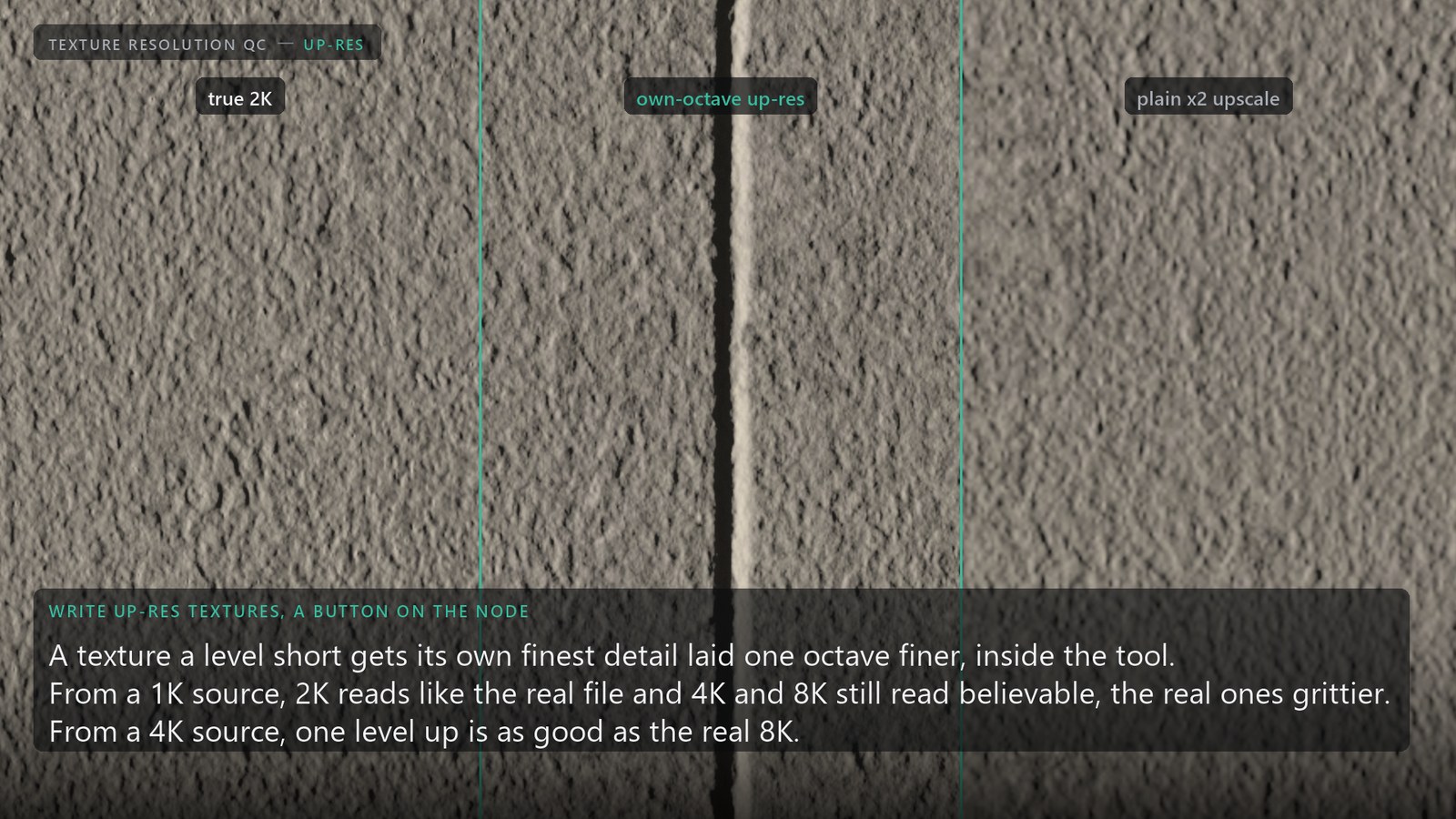
The hero asset that ships a level short cannot be re-textured overnight, and a plain upscale adds nothing. Write Up-res Textures, a button on the Texture Resolution QC node, lays the detail a texture already holds one octave finer, and every claim about it is measured against the real files.
01
How it works
The tool lays the detail a texture already holds one octave finer: for every output neighborhood, its low band is matched against the input's own low band nearby, at the input's pixel scale, and the matched spot's finest detail becomes the new octave, scaled to the energy the texture's own octave decay predicts. One match per material keeps albedo, normal, roughness and height coherent; the filters wrap, so tiling maps stay seamless; a UDIM set is written whole; the files land as tiled .tx and the resized layer points the materials at them. The pieces are found by PatchMatch over the whole input, read at the output's own pace: the textbook local self-example at 2x pastes every feature twice and turns grain into strokes.
02
Measured against the real files
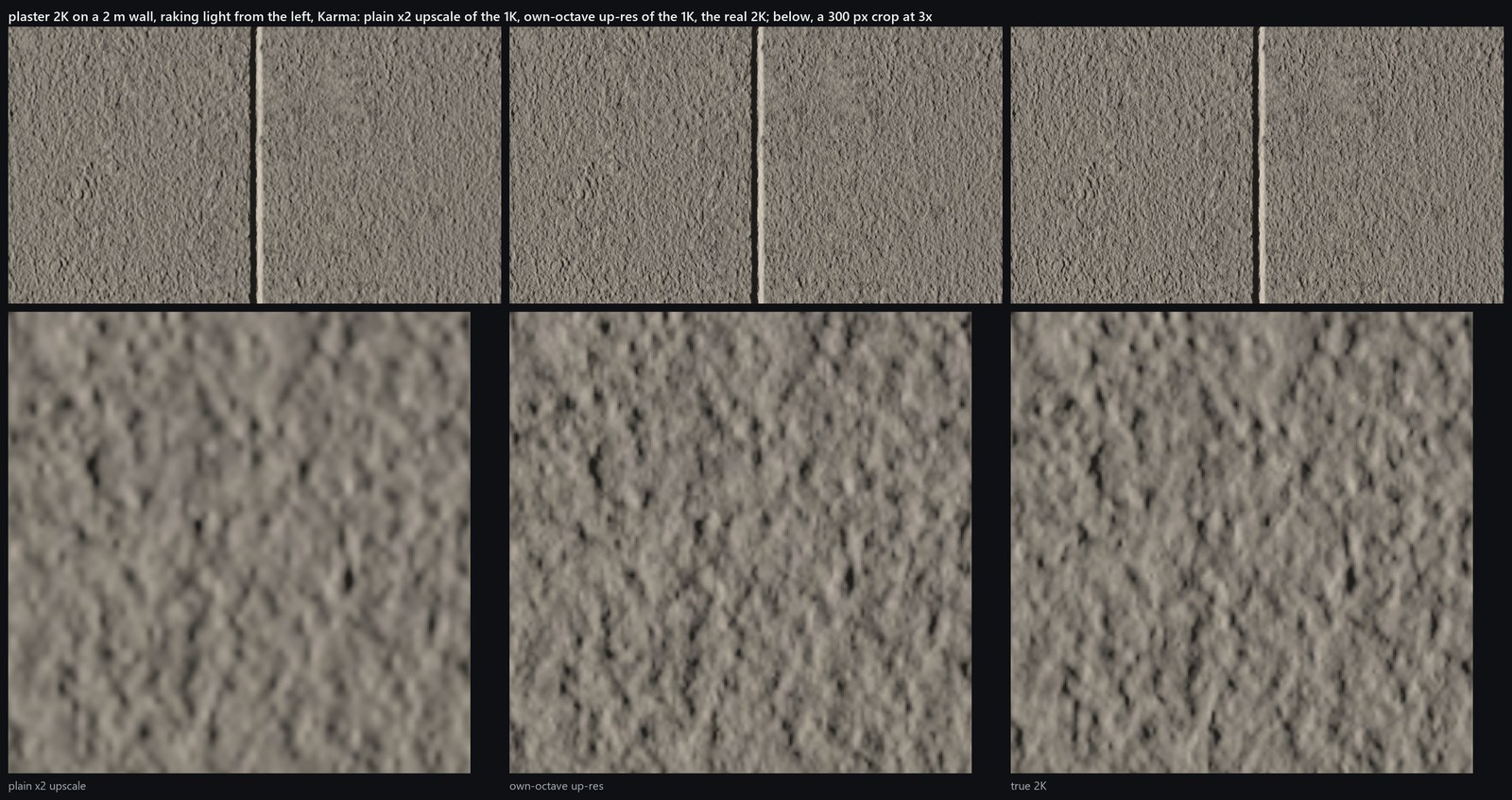
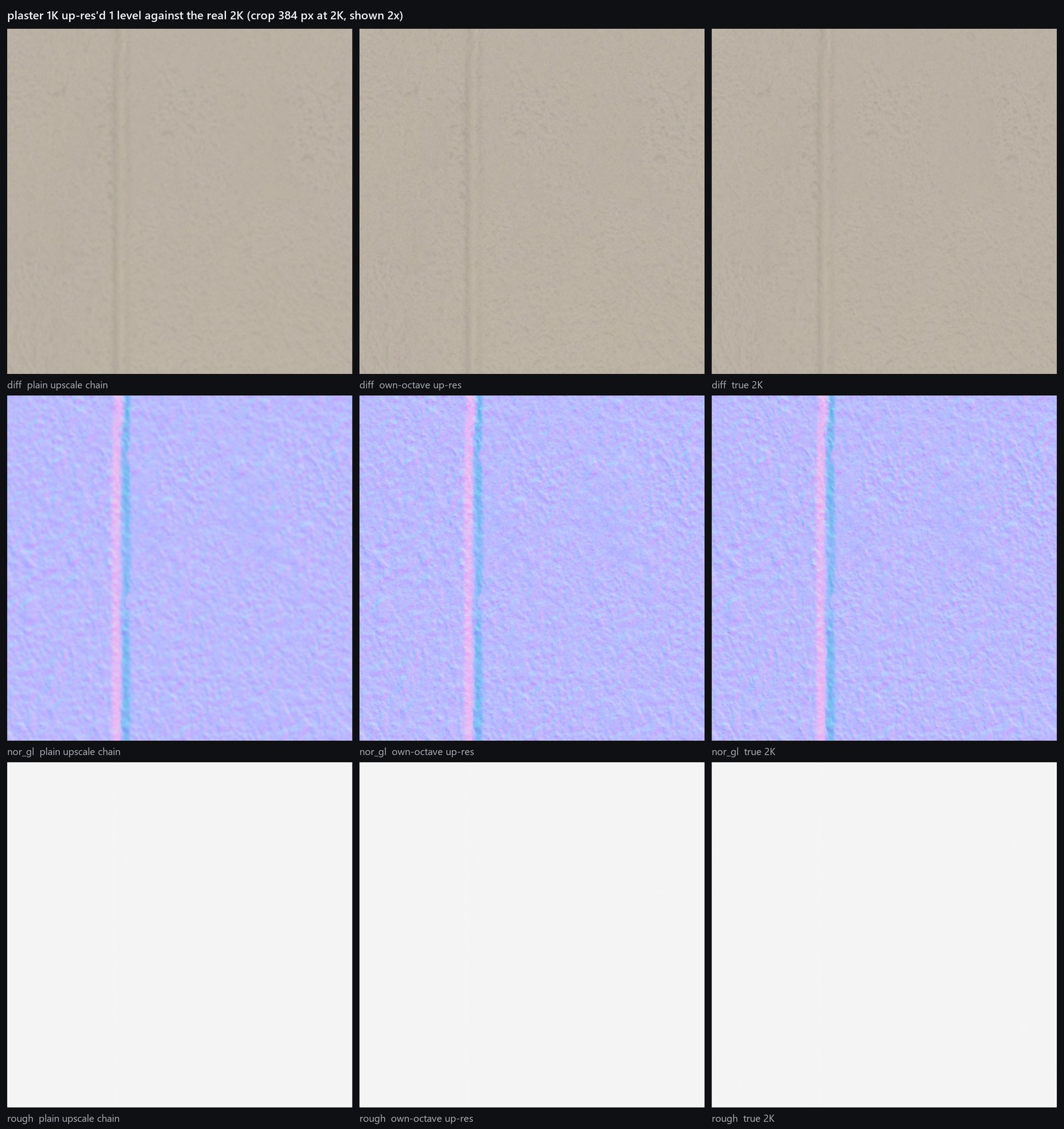
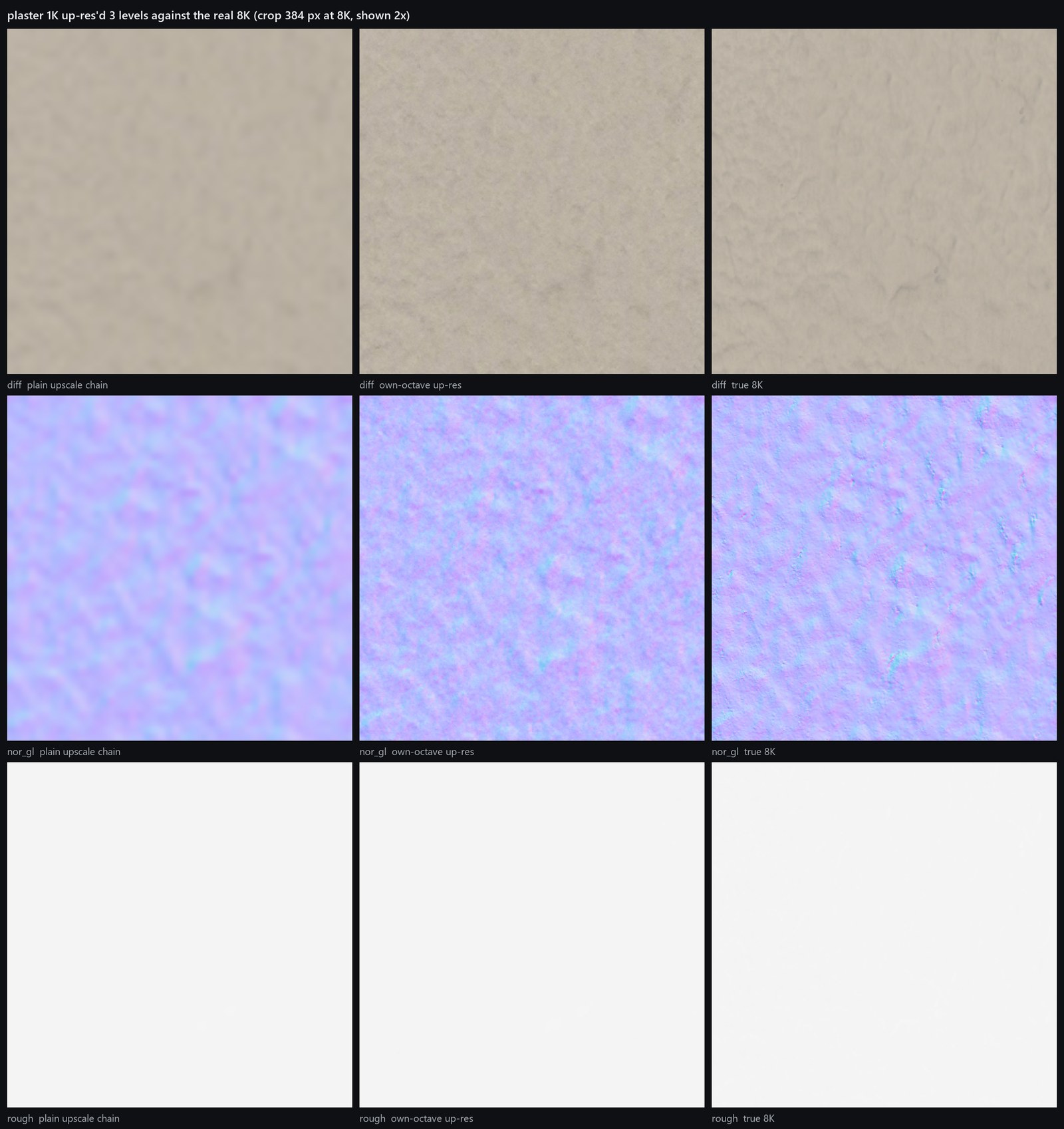
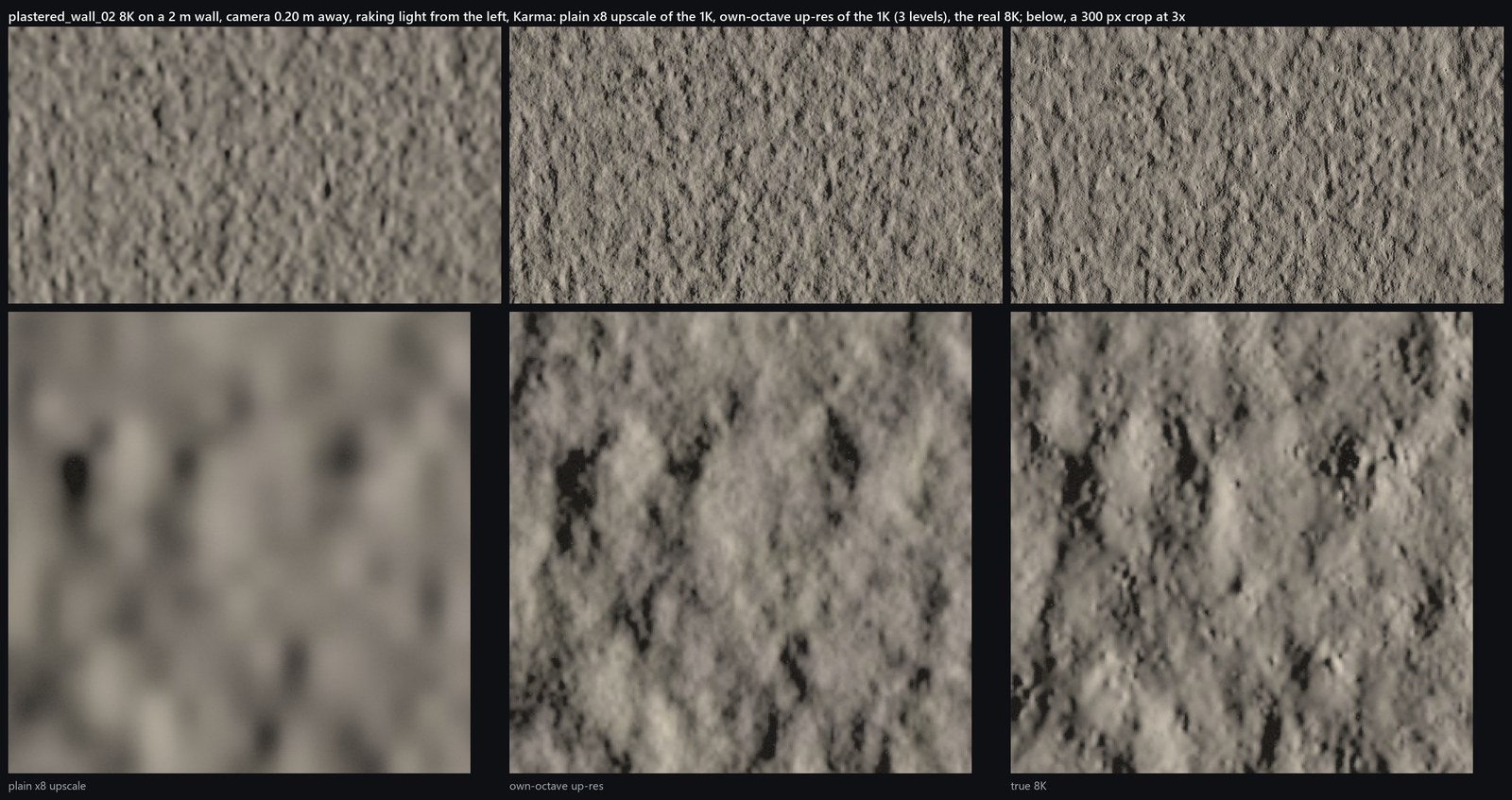
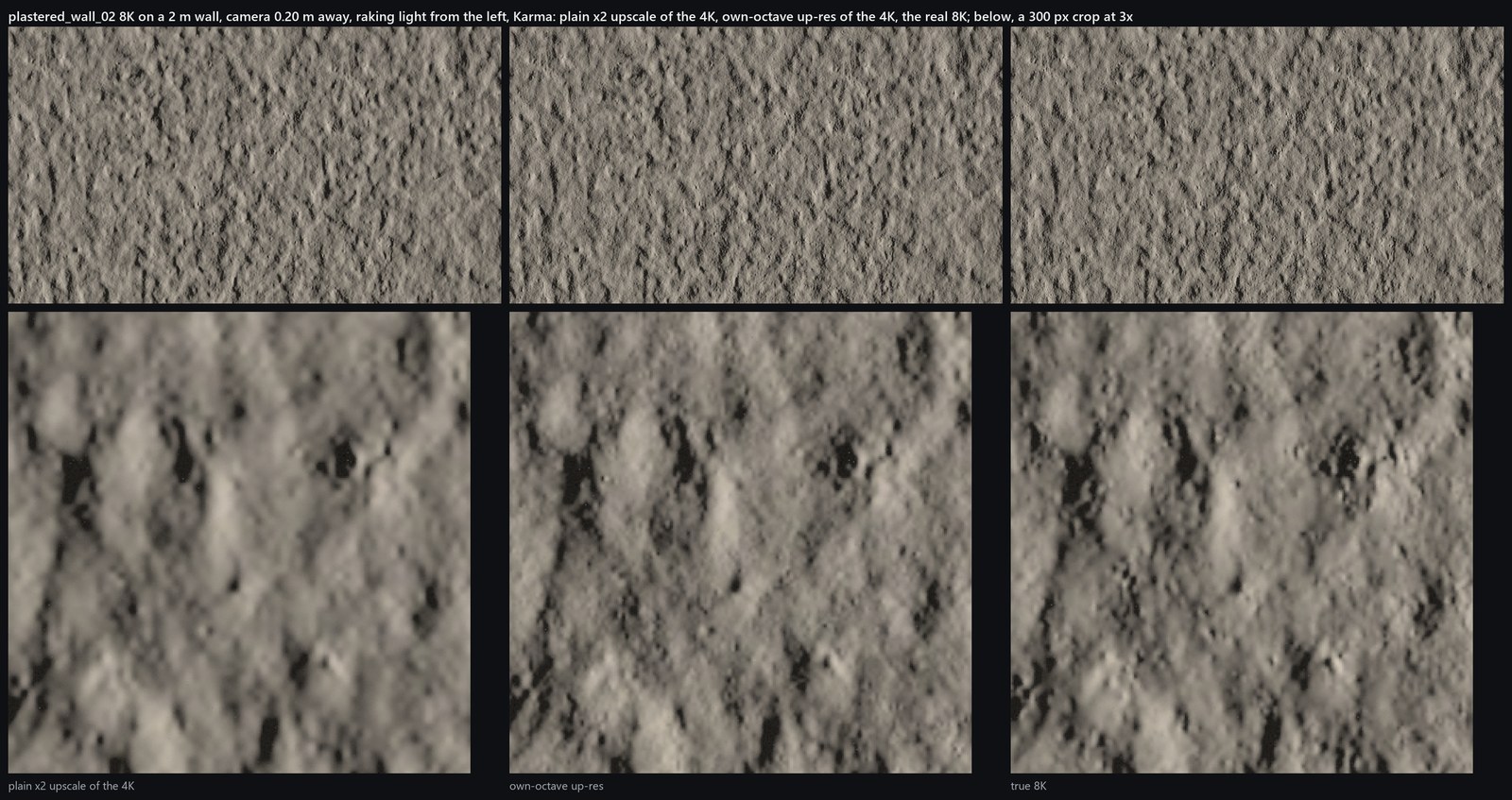
It is an estimate, and it is measured: the alley's plaster, 1K up one level against the real 2K from Poly Haven, carries a top octave whose spectrum shape is within a few percent of the true file's, 25 % too strong in energy in the albedo, 7 % in the normal map, and a fifth of it in the roughness, whose structure only appears at 2K. A plain upscale holds 5 %. Chained against the real 4K and 8K: at 4K the look holds and the amounts drift, at 8K the real plaster turns into fibers the 1K never held and the energies are off by 3x. One level is honest, two is a stretch, three is a guess that still reads as the wall under the light, measured rather than assumed; the report of the next cook says what the file really holds.
The maps alone overstate the softness: a normal map is judged by its shading, and under a raking light the up-res wall and the real wall read alike, the real one keeping slightly sharper pits (its finest octave is sparser, a kurtosis of 0.8 against 0.25; the up-res raises its own by a crispness step, and the rest is the limit of what a 1K can say).
03
Six other materials
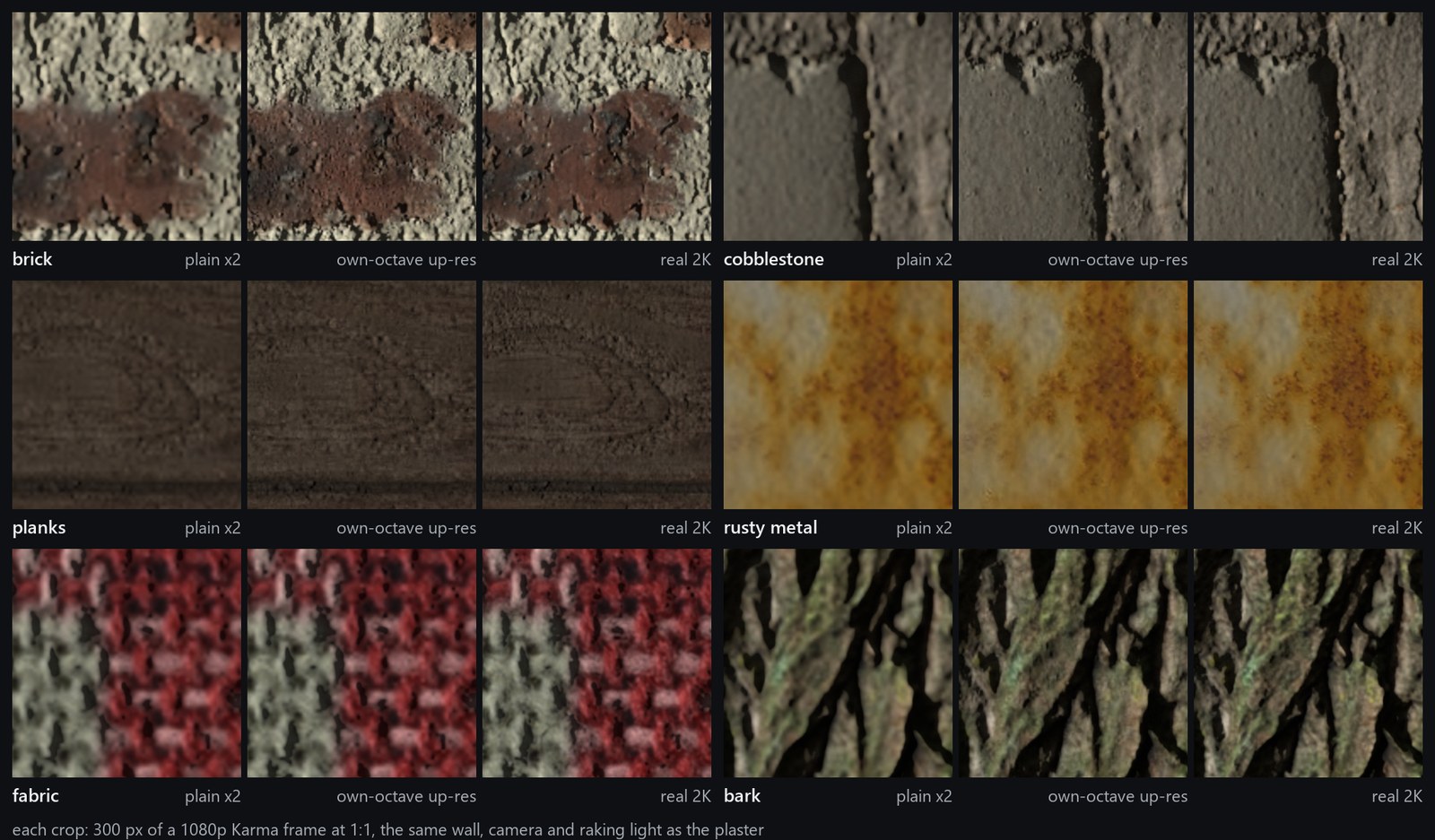
Six other materials went through the same judge: the stochastic ones hold, a regular weave does not (its next octave is its fibers, which the 1K never held), and a map that is smooth at the top gets a noise octave the material never had. The method cannot tell no detail there from detail it has not seen.
04
The whole alley from 1K
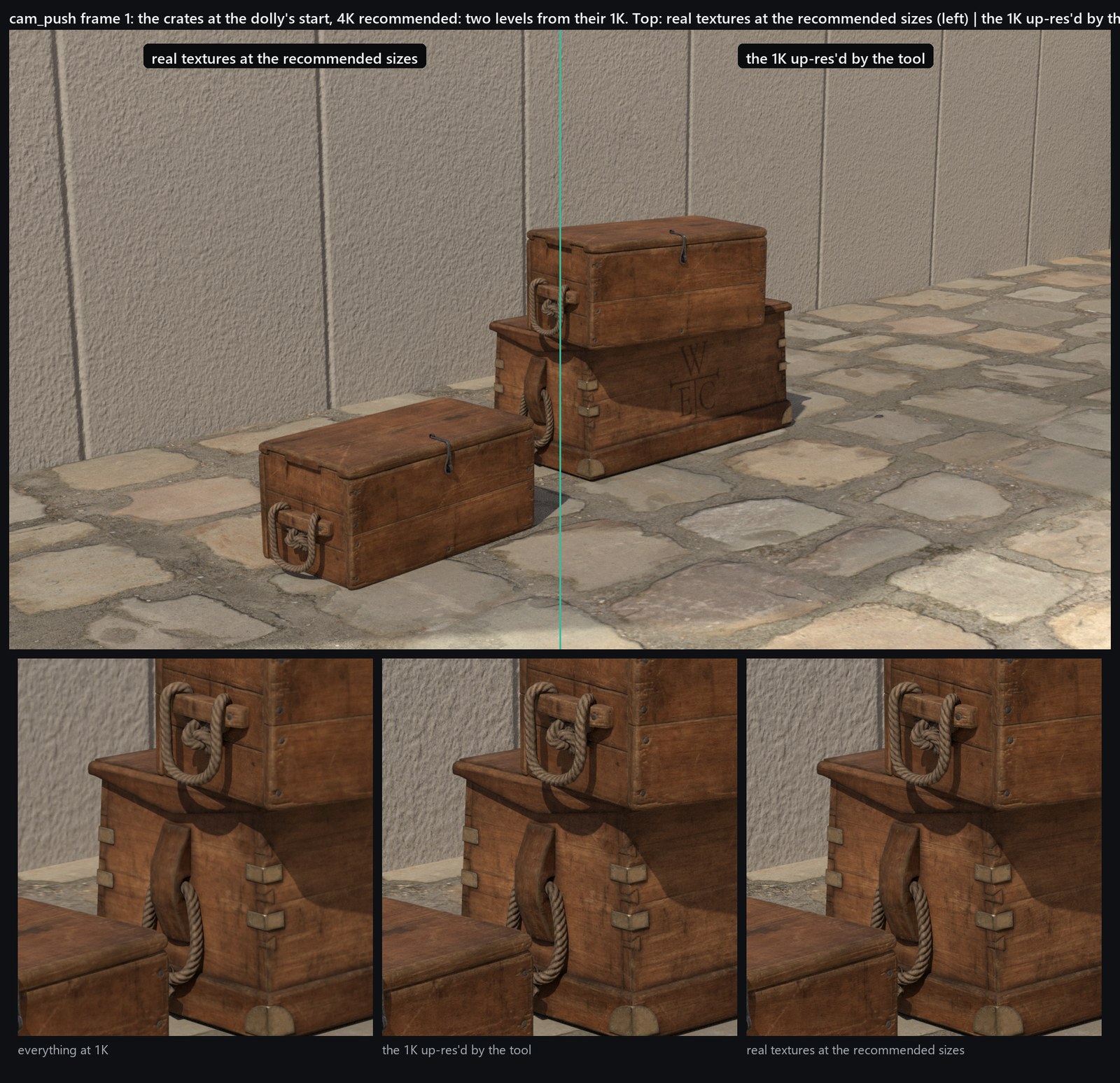
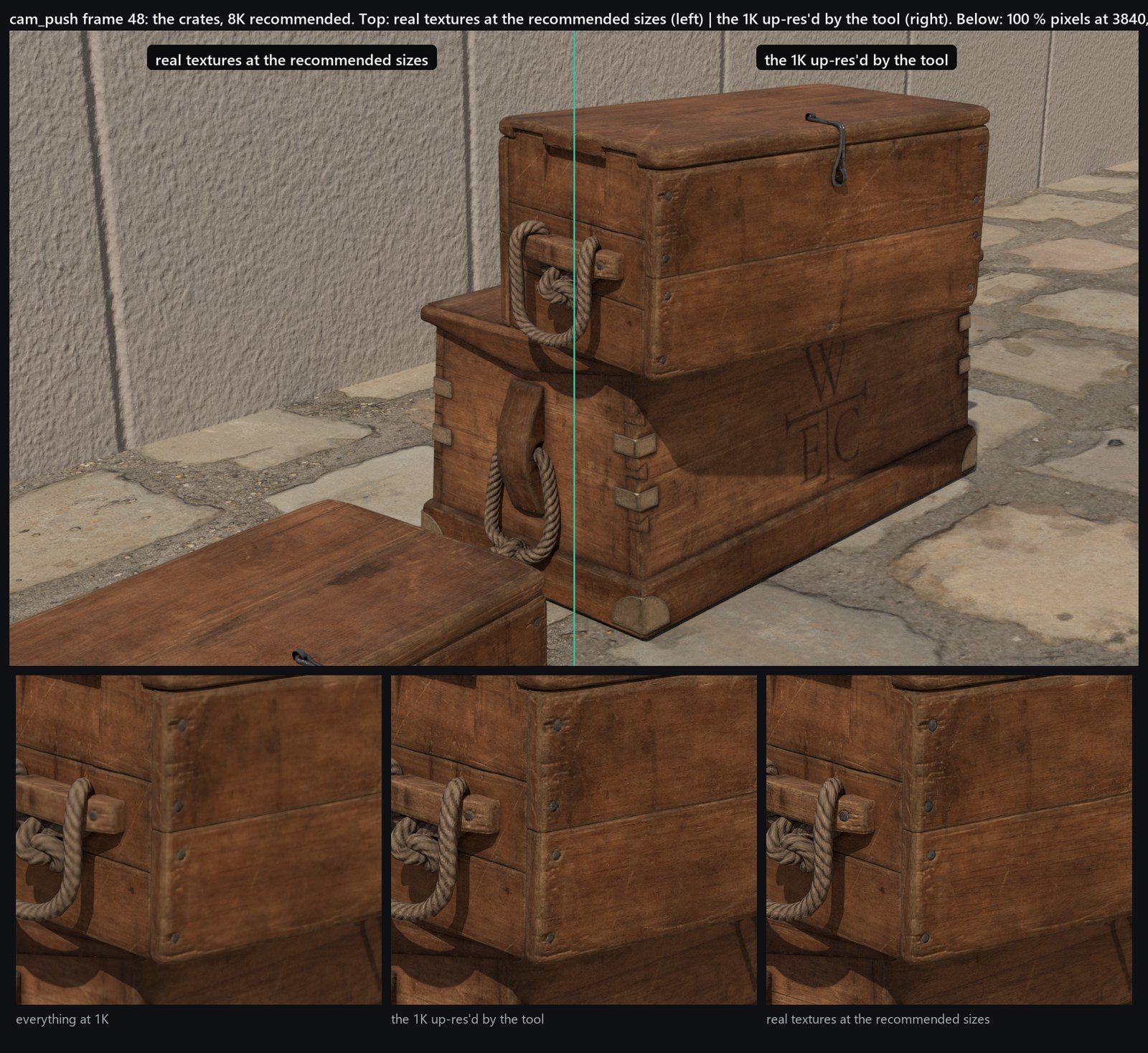
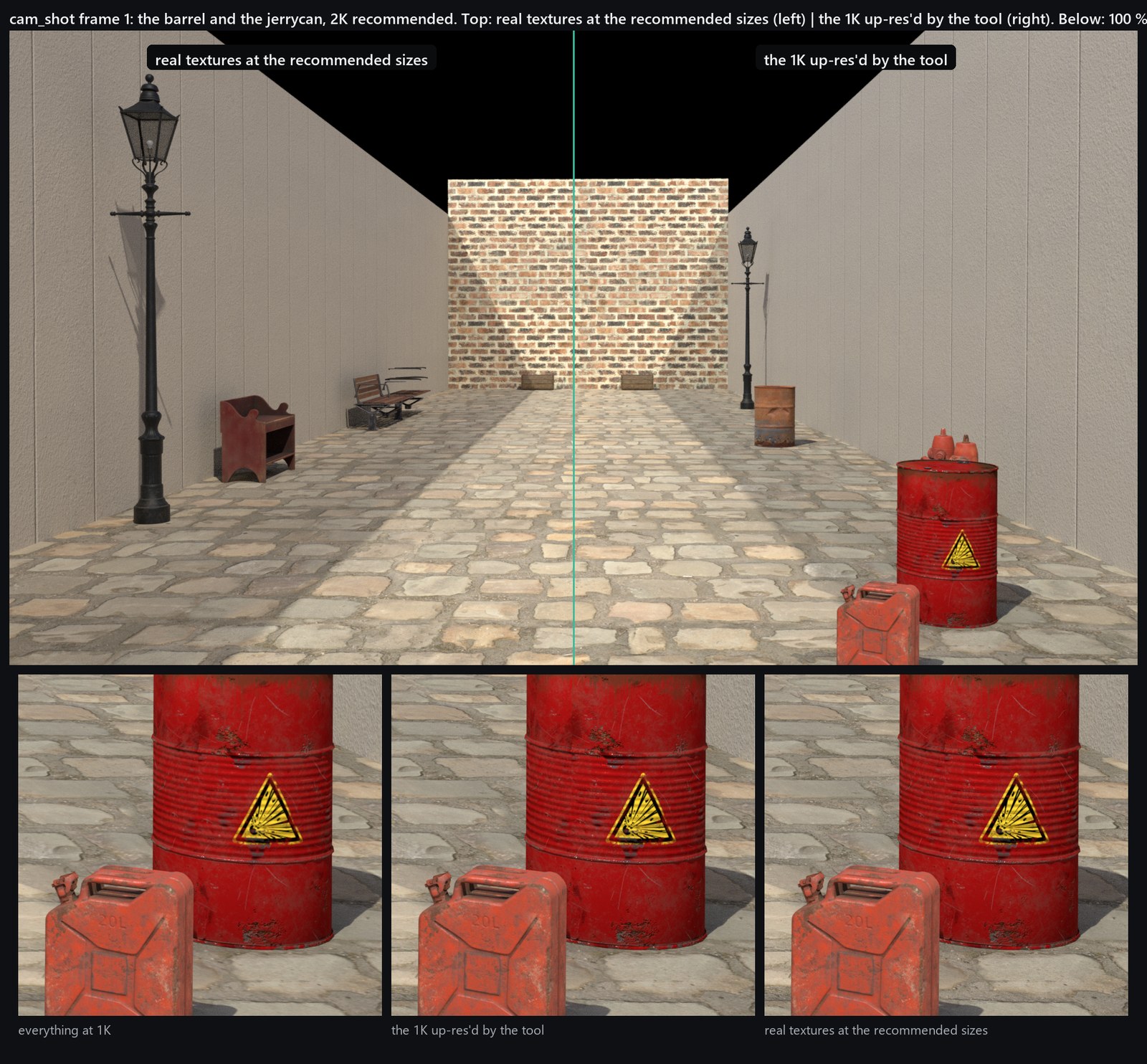
The scene test: every texture of the alley swapped to its 1K file, then Write Up-res Textures on the node, Up-res Levels 3, to the sizes the tool recommended (Size Per = Object, measured on 30 Oct with the first footprint metric, area): the crates, the cobblestone and the near plaster wall three levels to 8K, the stove, the seating and the lamps two to 4K, the barrel, the jerrycan, the bench and the back wall one to 2K. Today's defaults give the crates, the cobblestone, the walls, the barrel and the jerrycan the same sizes, so the crops below stand. 36 files, 53 minutes, 16 GB peak, one button. Rendered against the real Poly Haven files at those sizes from the same cameras (demo/upres_scene.py), under a sun added for the comparison (the scene's dome alone left every normal map flat): at 1080p the two alleys are the same picture; at 100 % of a 3840 render the crates at the dolly's start, 4K needed from their 1K, read as the real file after two levels, and at the dolly's end, 8K after three, the grain is still the crate's own while the real scratches are finer.
Part of Texture Resolution QC, October 2026: the node measures the size each shot needs, and Write Up-res Textures fills the gap for the files that ship a level short. Houdini 22, Solaris, Karma. Demo assets CC0 Poly Haven.