Texture Resolution QC
- Houdini 22
- Solaris
- Karma
- USD
- Python
- VEX
- Copernicus
A LOP that measures, per prim and per UDIM tile, the texture resolution the shot cameras actually read, paints the answer on the geometry, checks it against what Karma samples, and writes the textures and the USD layer that act on it.
01
Measured UVs rather than guessed
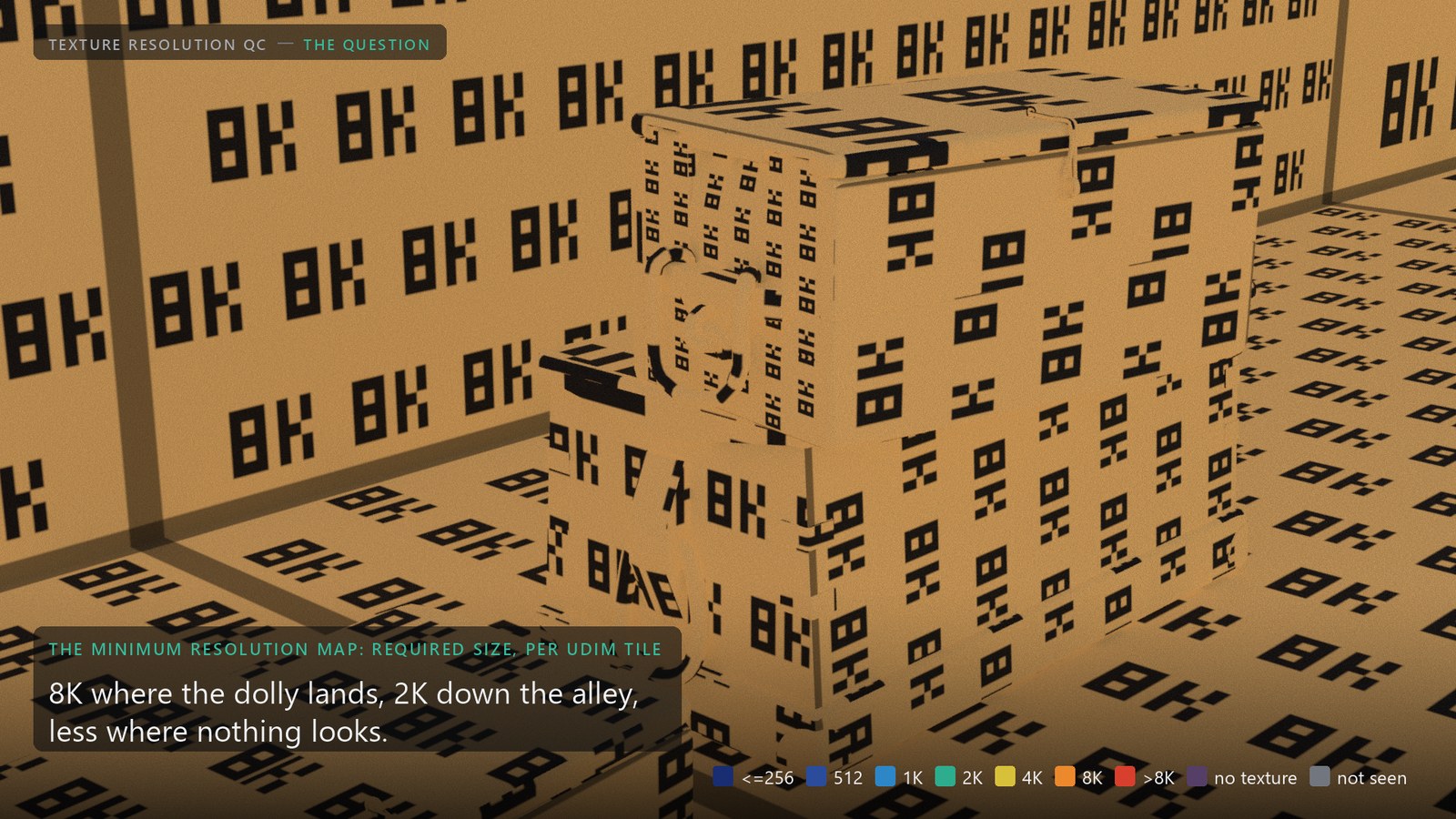
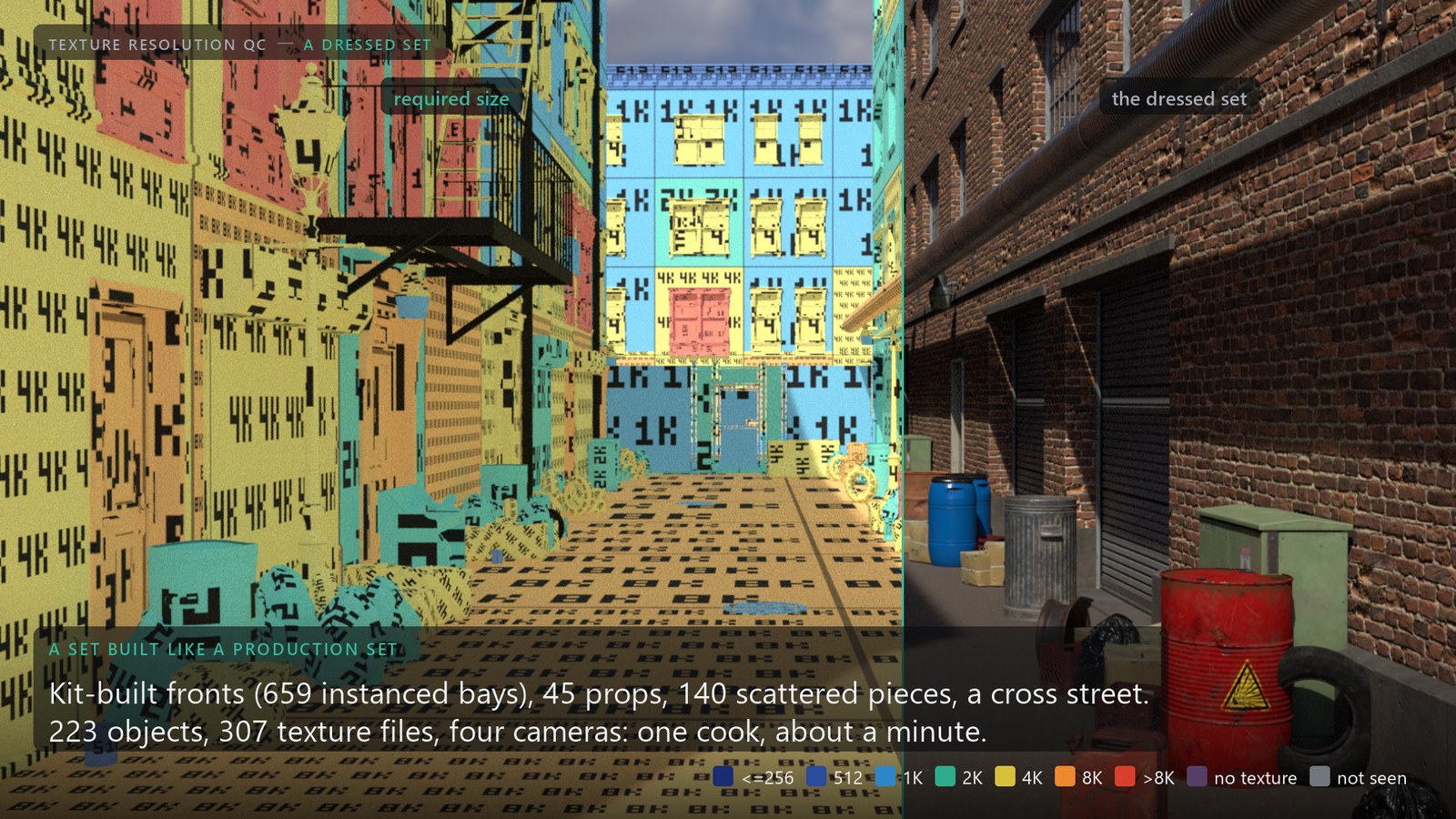
Texture sizes are usually decided before the shots exist: a vendor spec, a rule of thumb, whatever the asset came with. The tool measures instead: from the shot cameras, the minimum resolution every prim and UDIM tile needs. Its main job is the asset that ships too small, the 4K hero prop a close-up reads at 8K, caught before dailies. Oversized backgrounds fall out of the same map.
02
The maths
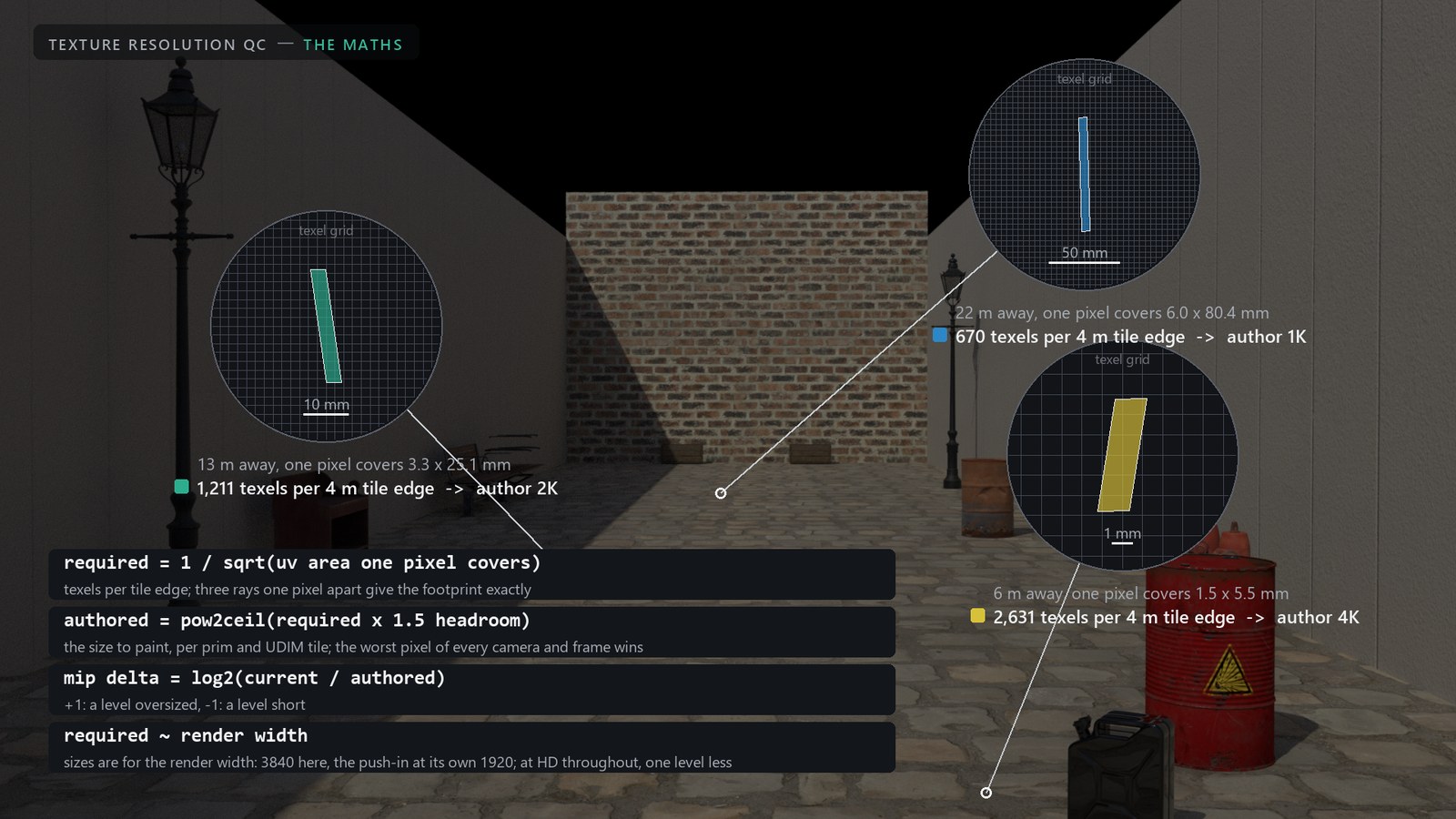
A render pixel covers a small parallelogram in uv space, and texels smaller than that are never read. The tool measures that footprint the way the renderer does, with ray differentials: three rays one pixel apart and the uv difference between their hits.
J        = [ du/dx  du/dy ]     uv change per screen pixel, from three rays one pixel apart
           [ dv/dx  dv/dy ]
required = 1 / texel_size(J)    texels per tile edge: the footprint's short axis (minor), as Karma picks the level
authored = pow2ceil(required x 1.5)
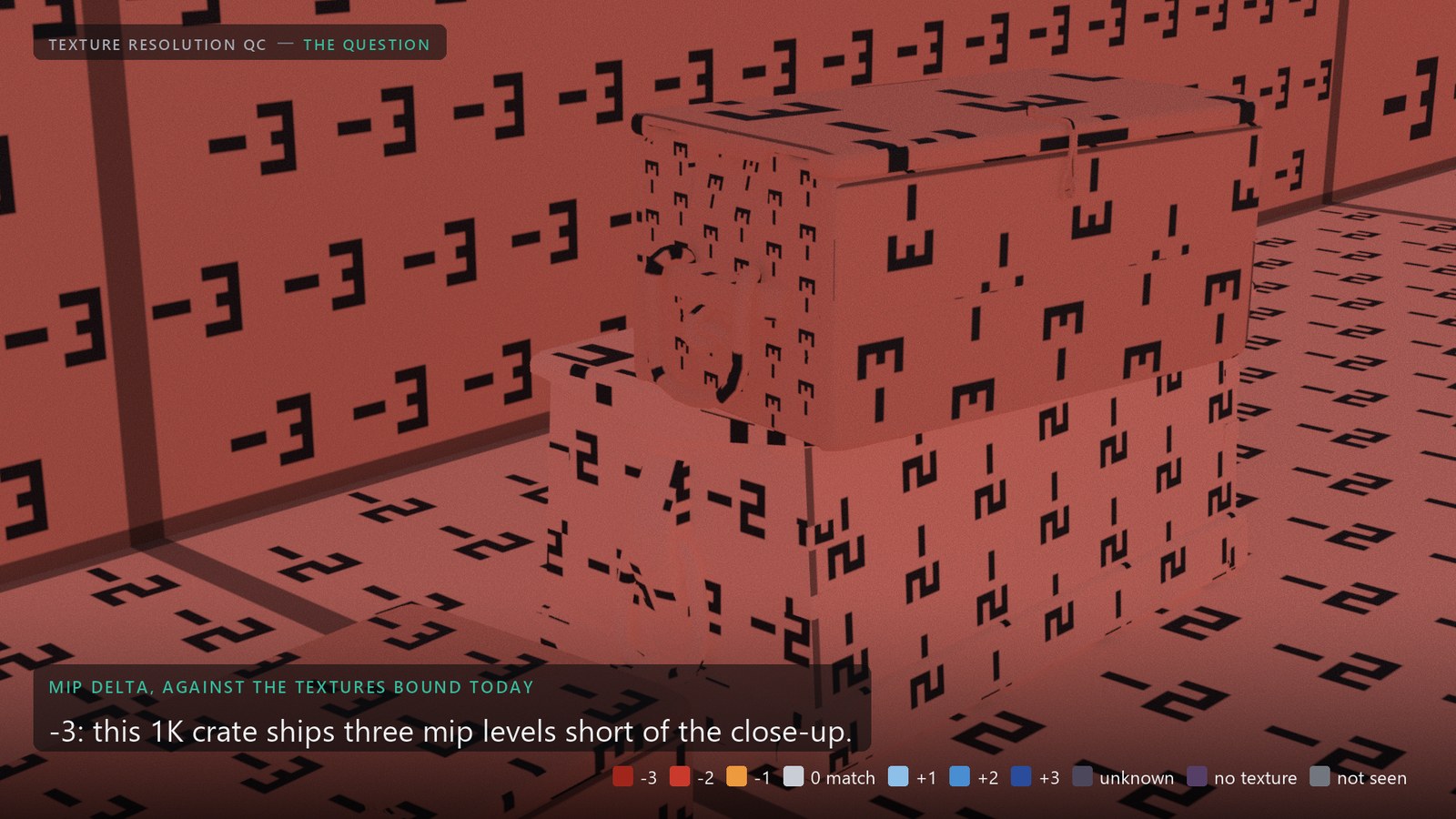
mip delta = log2(current / authored)      +1 oversized by a level, -1 a level short
density needed = 1 / footprint on the surface        pixels per meter the camera puts there, same metric, blind to the uv layout
density today  = current x sqrt(uv area / world area)   what the bound texture gives per meter
Every size is for the render width. The reference is 3840; the push-in renders at 1920 and is measured there. Required scales with the width: a show at HD throughout asks one level less.
Which axis of the footprint
| Metric | Texel size | Matches |
|---|---|---|
minor (default) | the short axis, clamped by Max Anisotropy (16) | how Karma CPU and XPU pick the mip level |
area | geometric mean of both axes | isotropic mip selection; one level too coarse on surfaces seen at an angle |
major | the long axis | trilinear filtering without anisotropy: the most conservative |
Frontal surfaces agree under every metric; grazing walls and floors differ by a level.
03
How it runs
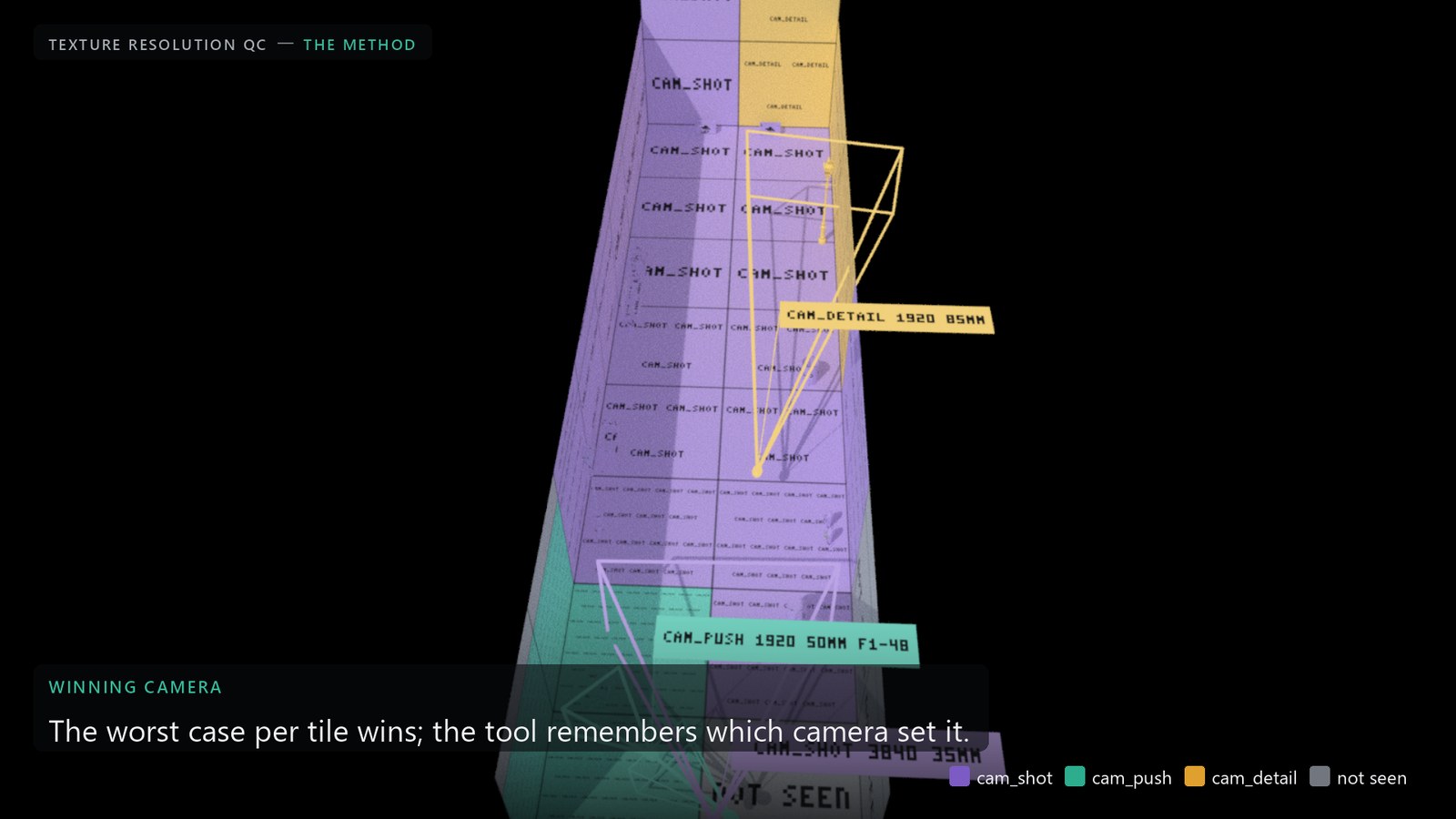
Ray engine (default). A ray grid from every shot camera every N-th frame, VEX intersect() against the render geometry, an analytic footprint per ray. Seconds on a set, no render setup, and it updates as the camera moves.
Karma image engine. The same maths on rendered AOVs (prim id and st), so subdivision, displacement, motion blur and depth of field are included.
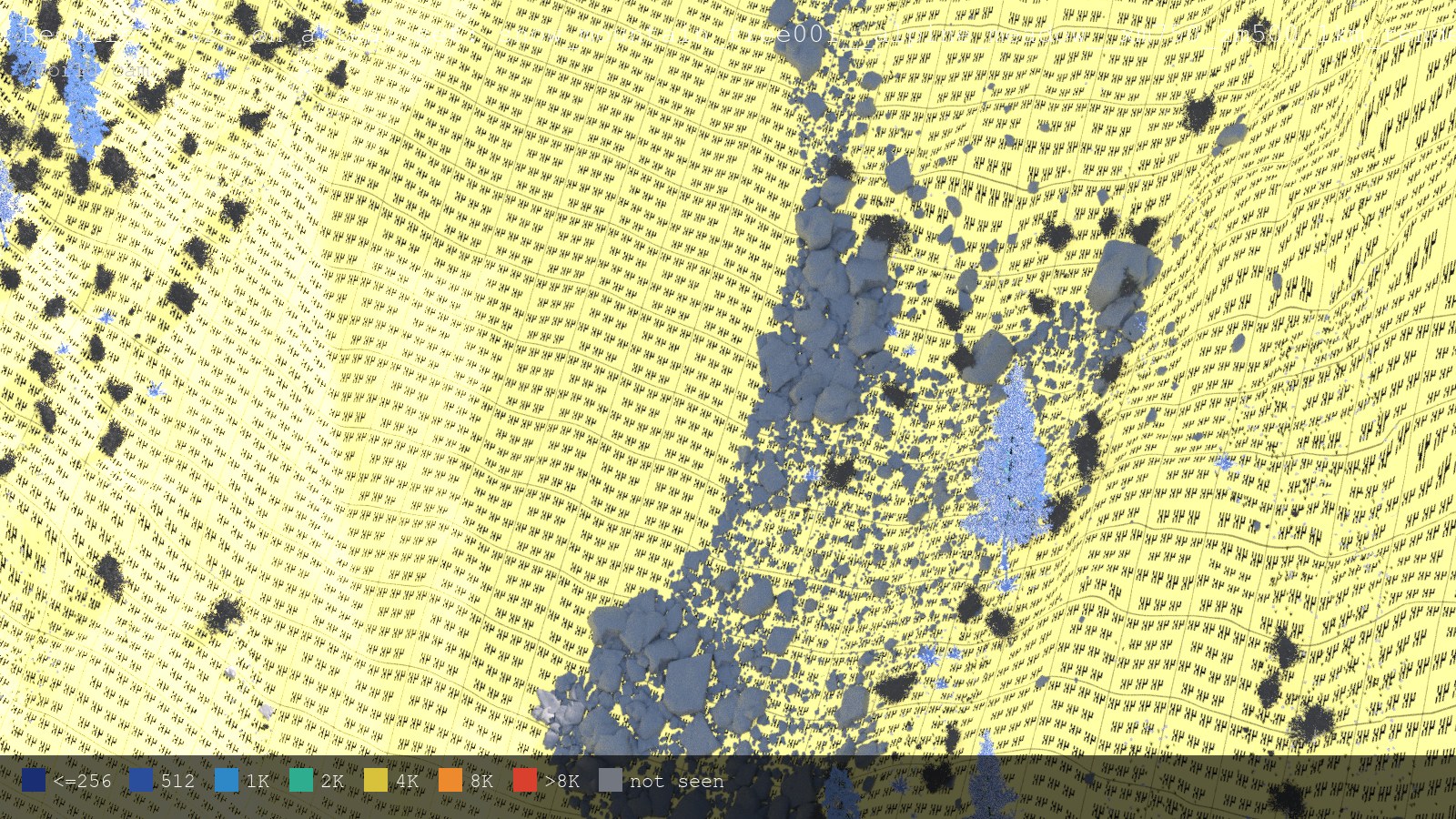
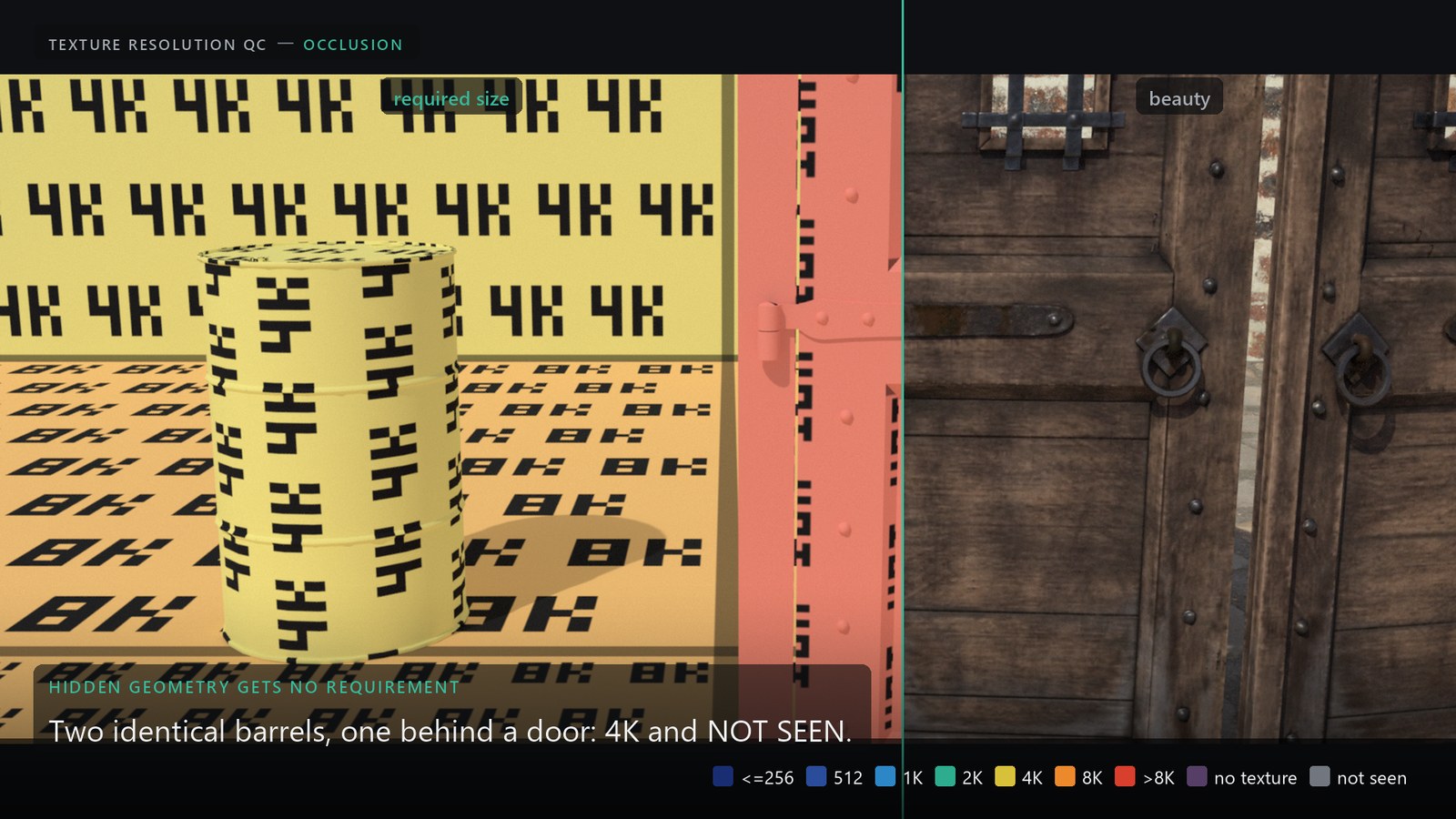
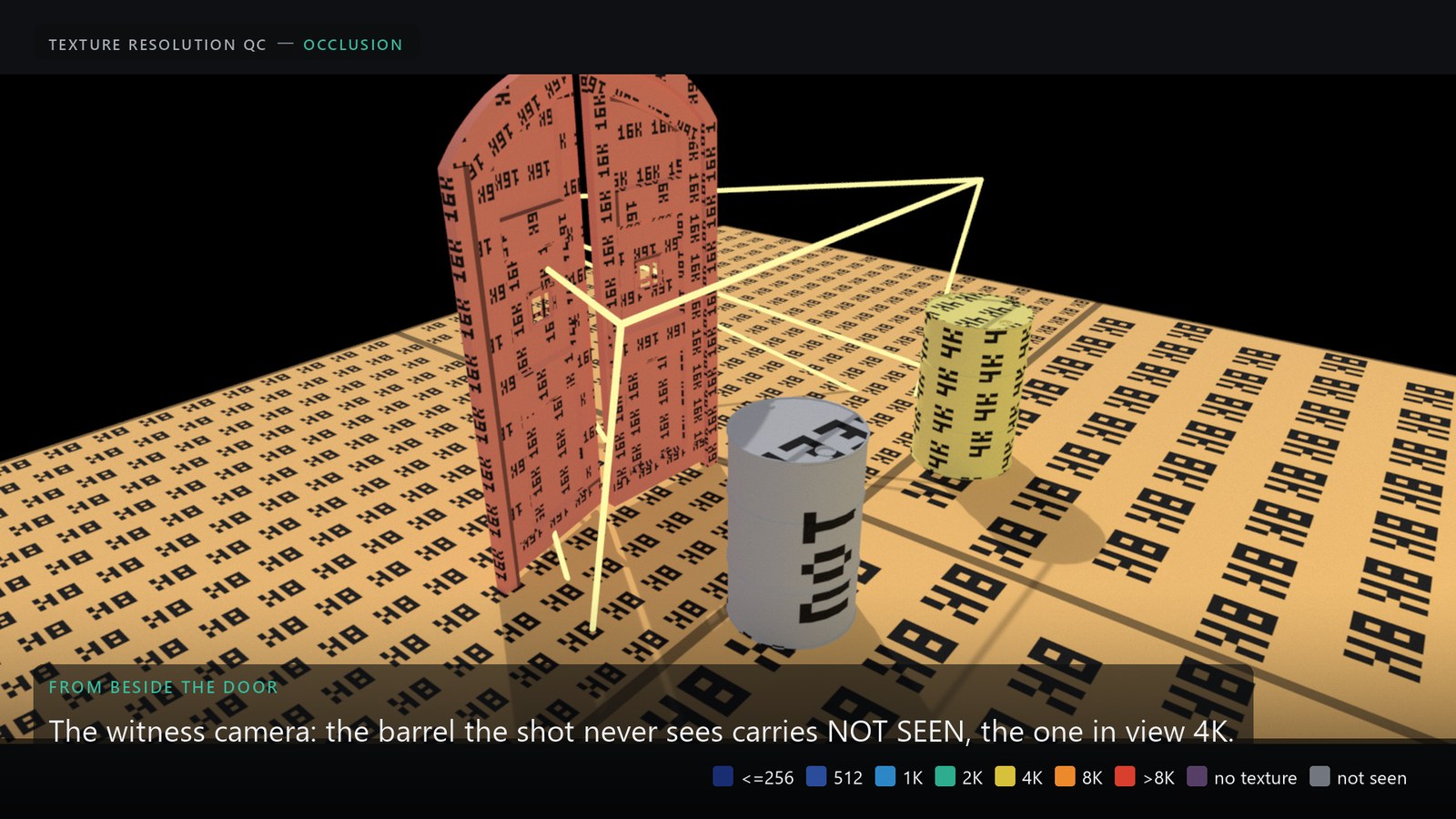
Occluders. Anything the render sees blocks the rays. A barrel behind a door reads NOT SEEN and gets the minimum size.
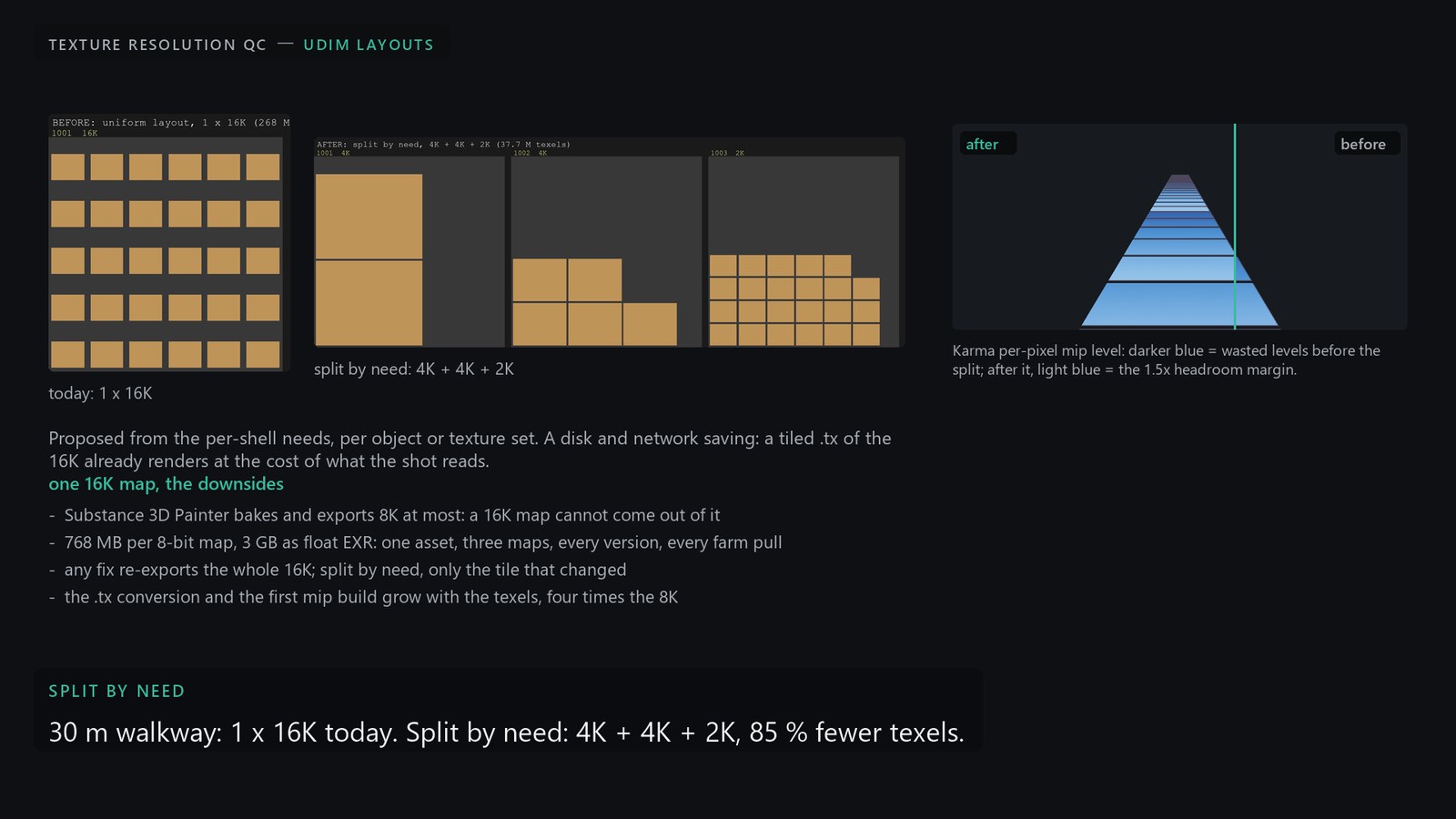
Aggregation. The maximum per prim and UDIM tile over every camera and frame. Size Per sets what shares a size: the object, the texture set, or each tile.
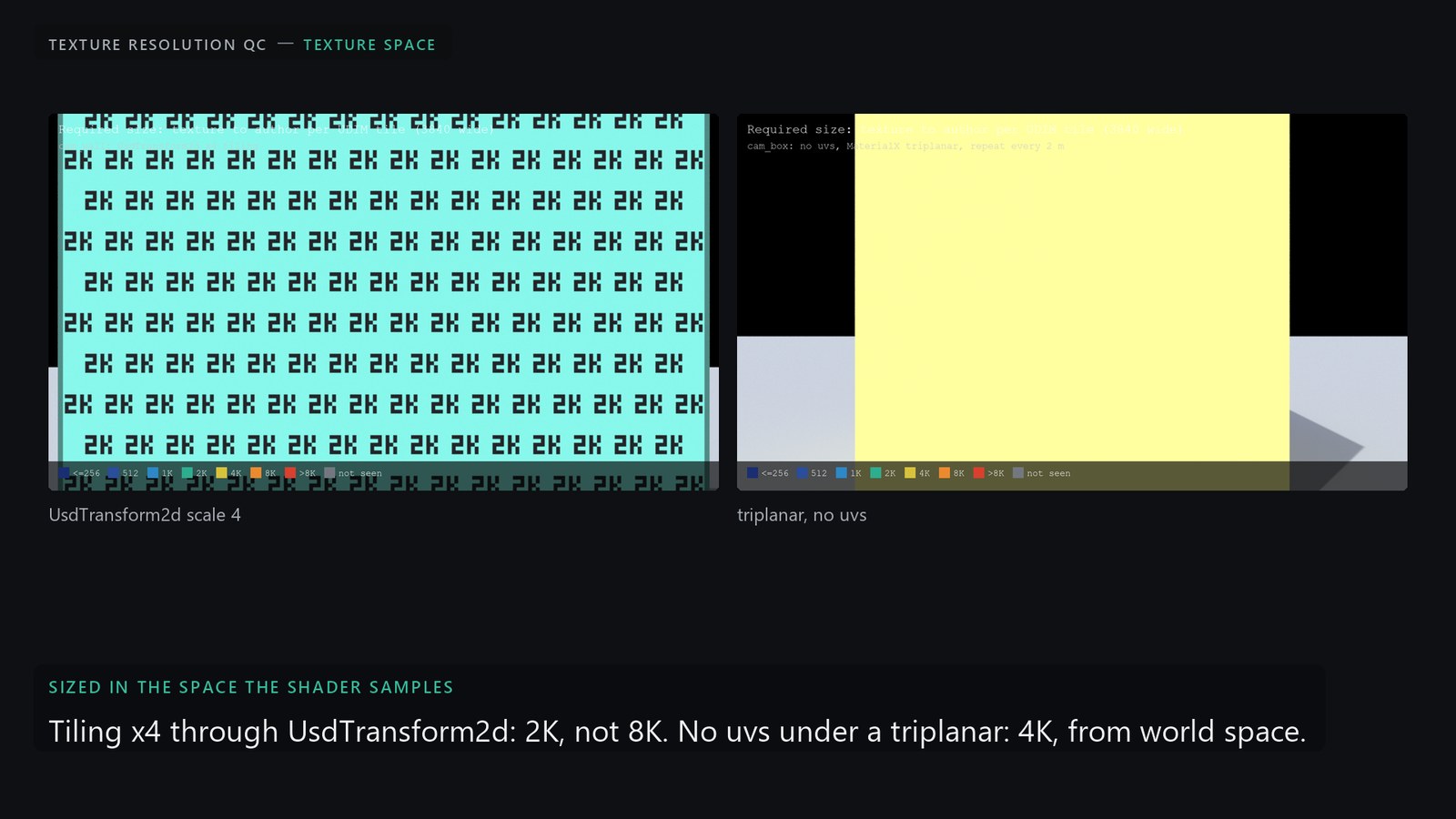
Texture space. Each map is sized in the space its shader samples: uv transforms and tiling are read from the material graph, triplanar maps are sized in world space.
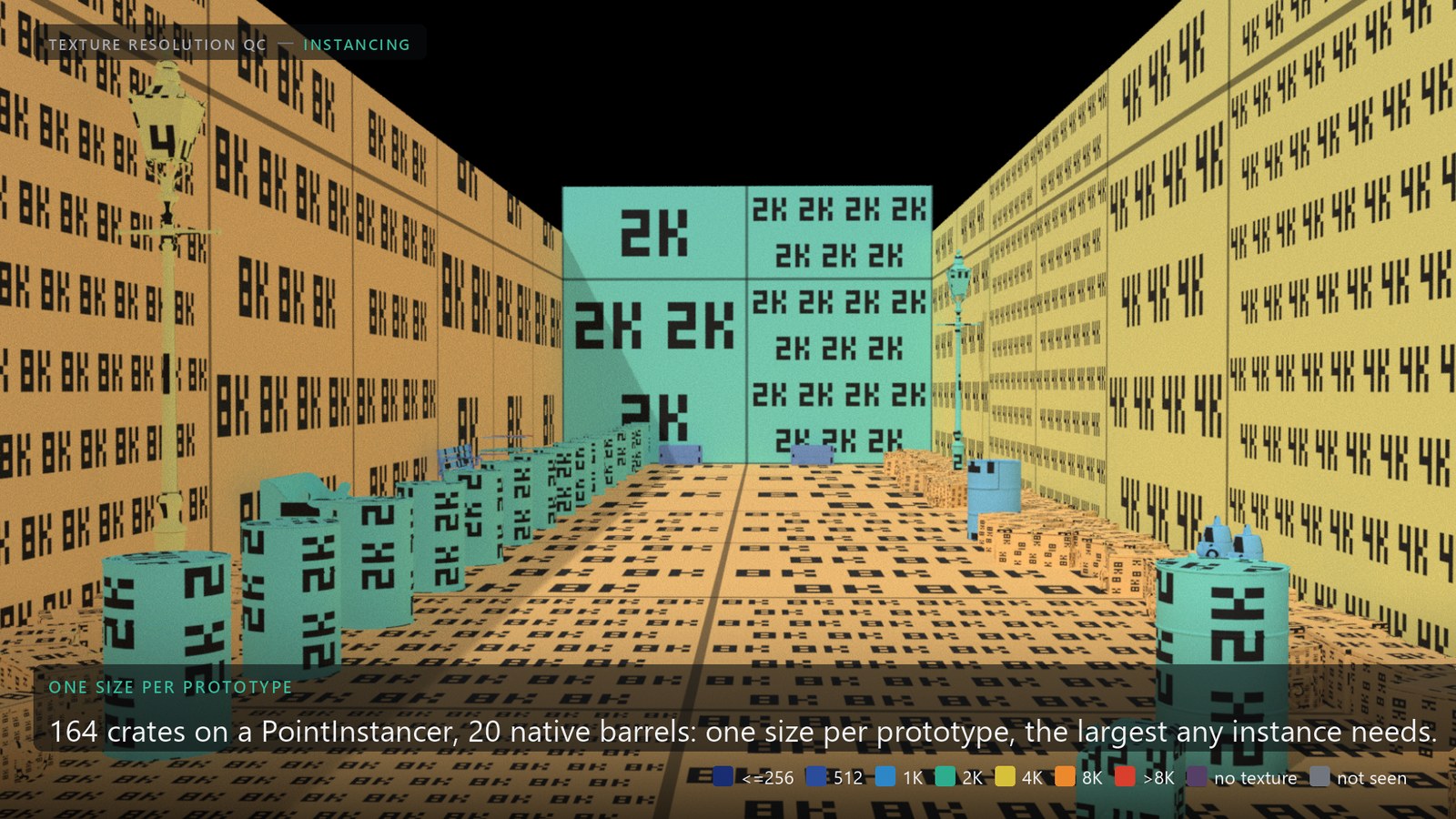
Instancing. One size per prototype, the largest any instance needs, traced on a sample of copies. A million-instance PointInstancer cooks in about a second.
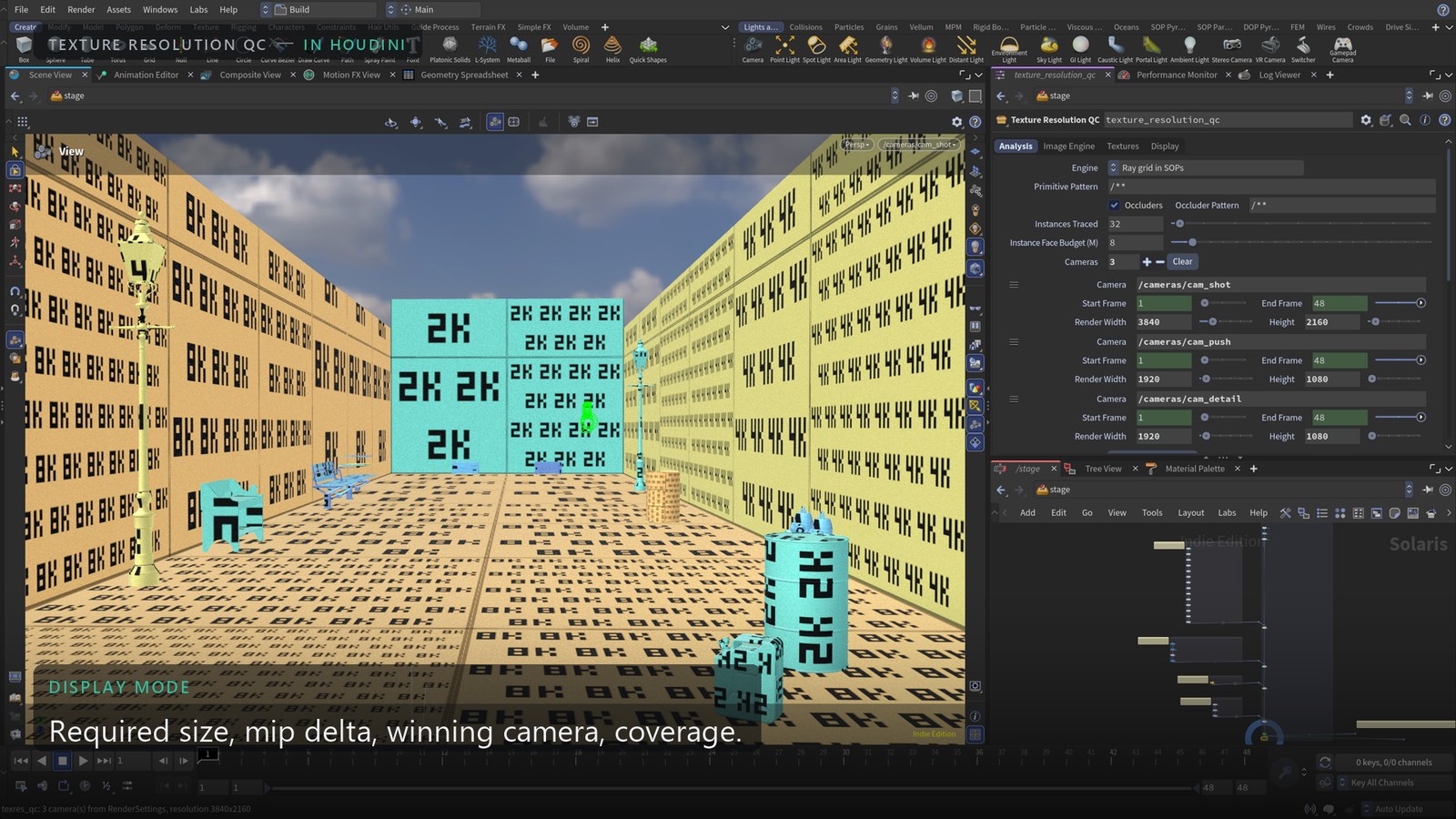
Viewport only. Drop the node after the set, press Cameras From Stage and set the display flag: the required sizes appear in Storm within seconds, with no render.
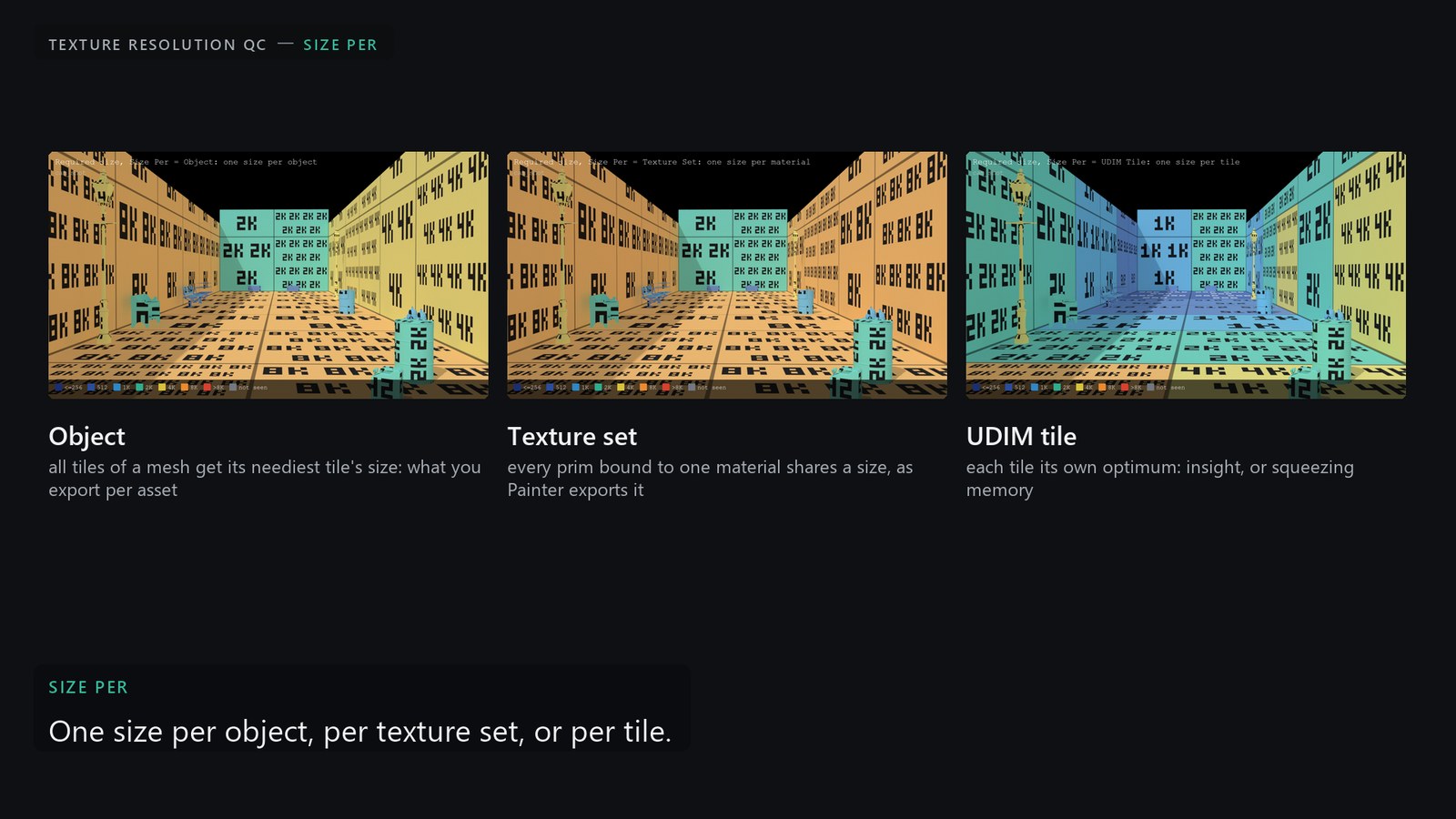
04
The views, in the viewport
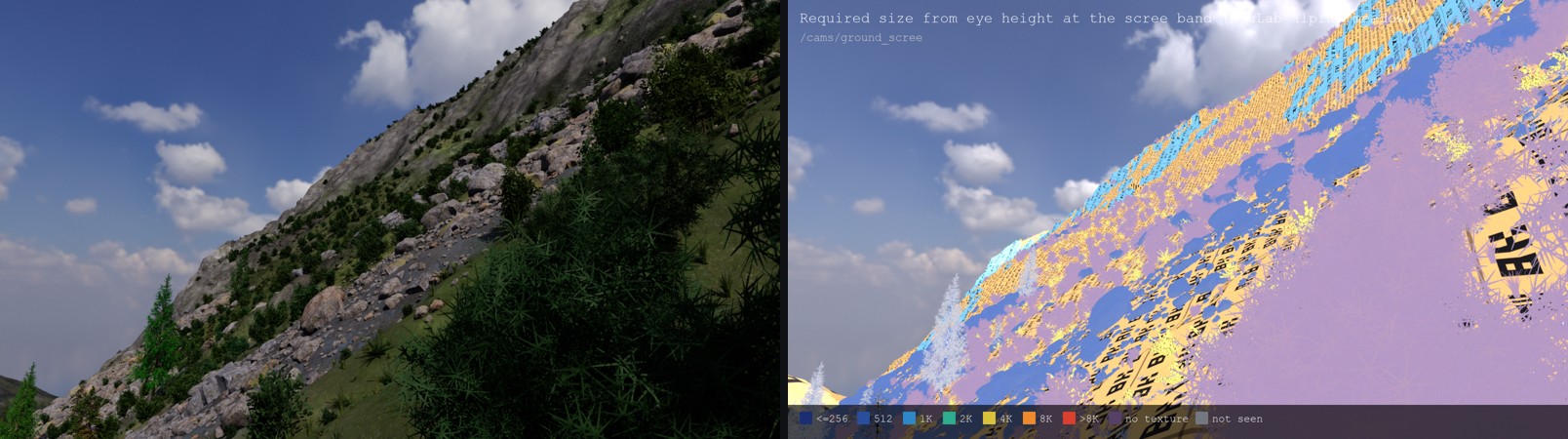
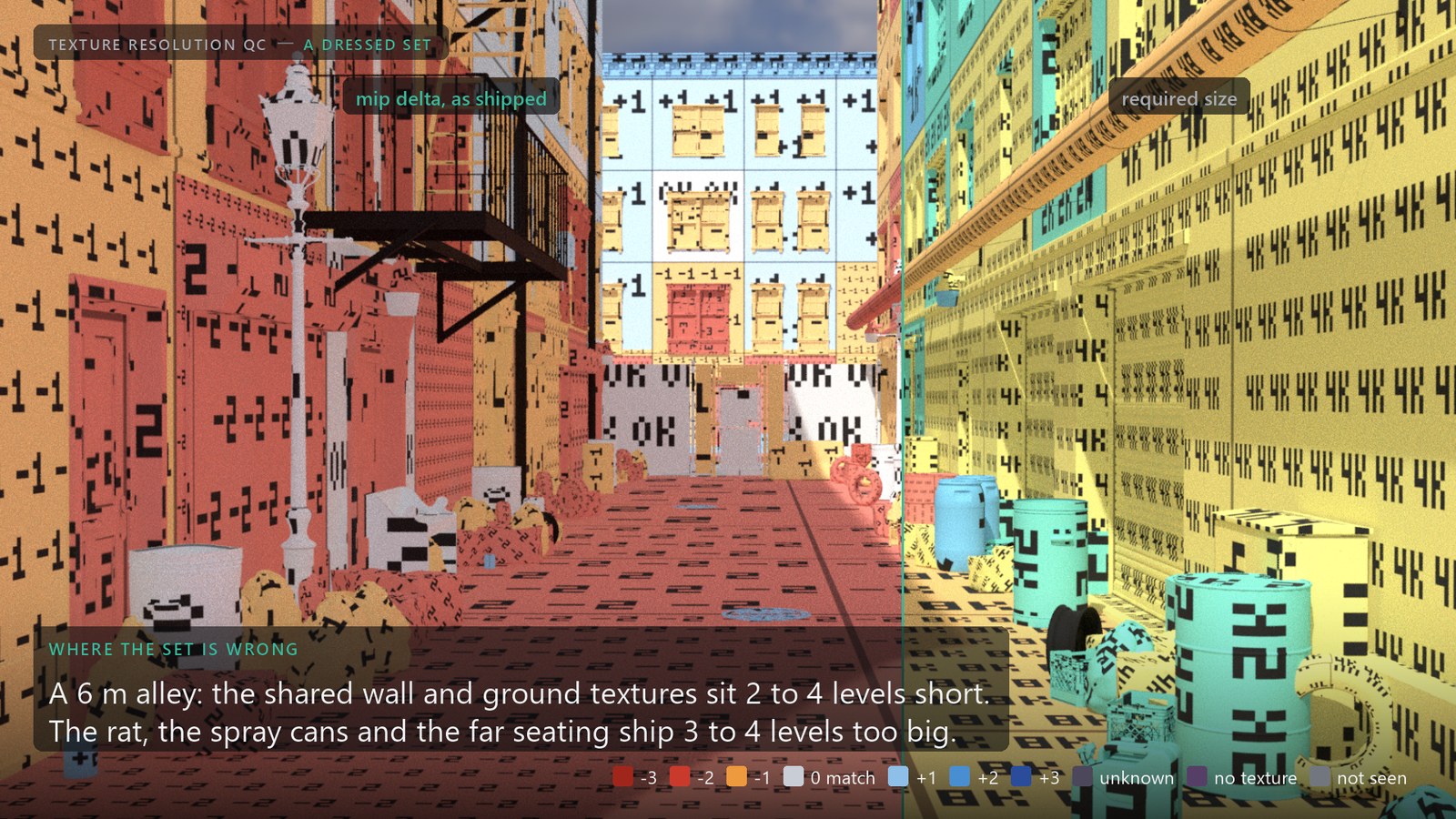
Painted on the geometry as display color plus a preview material, so it shows in Storm and in the Karma viewport, each tile labeled with its value.
No texture: the material binds only a flat color, so there is no size to set.
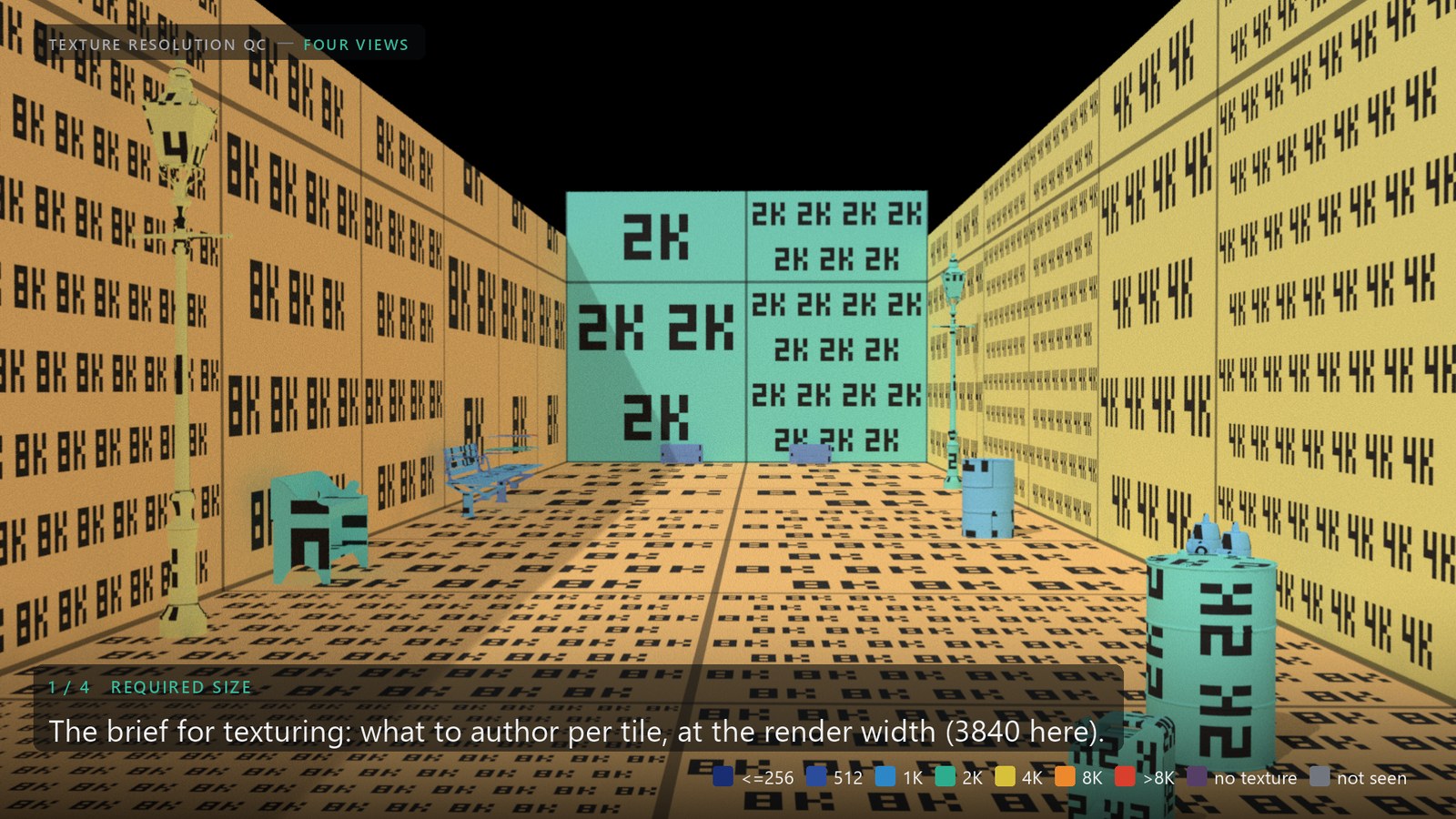
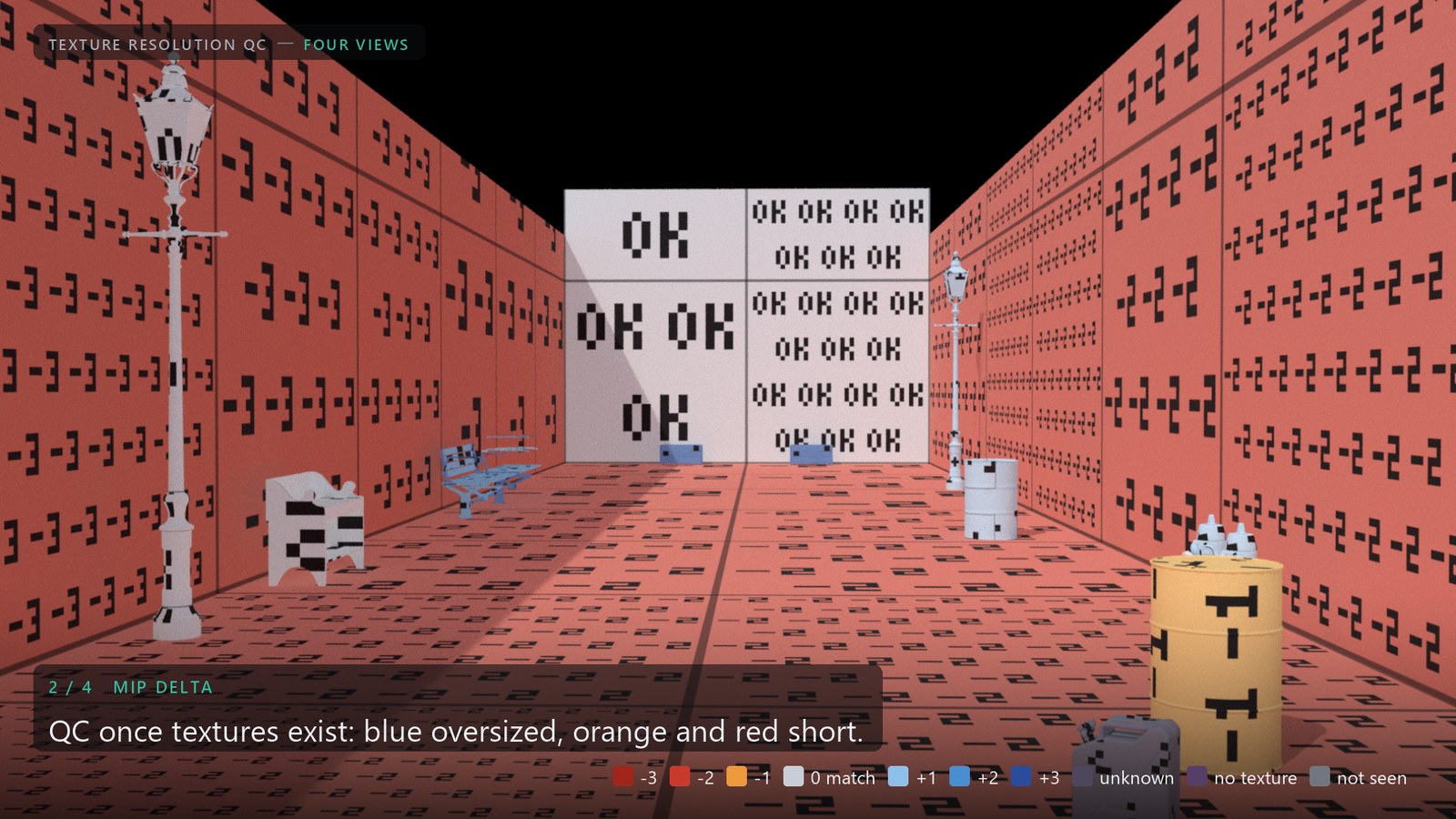
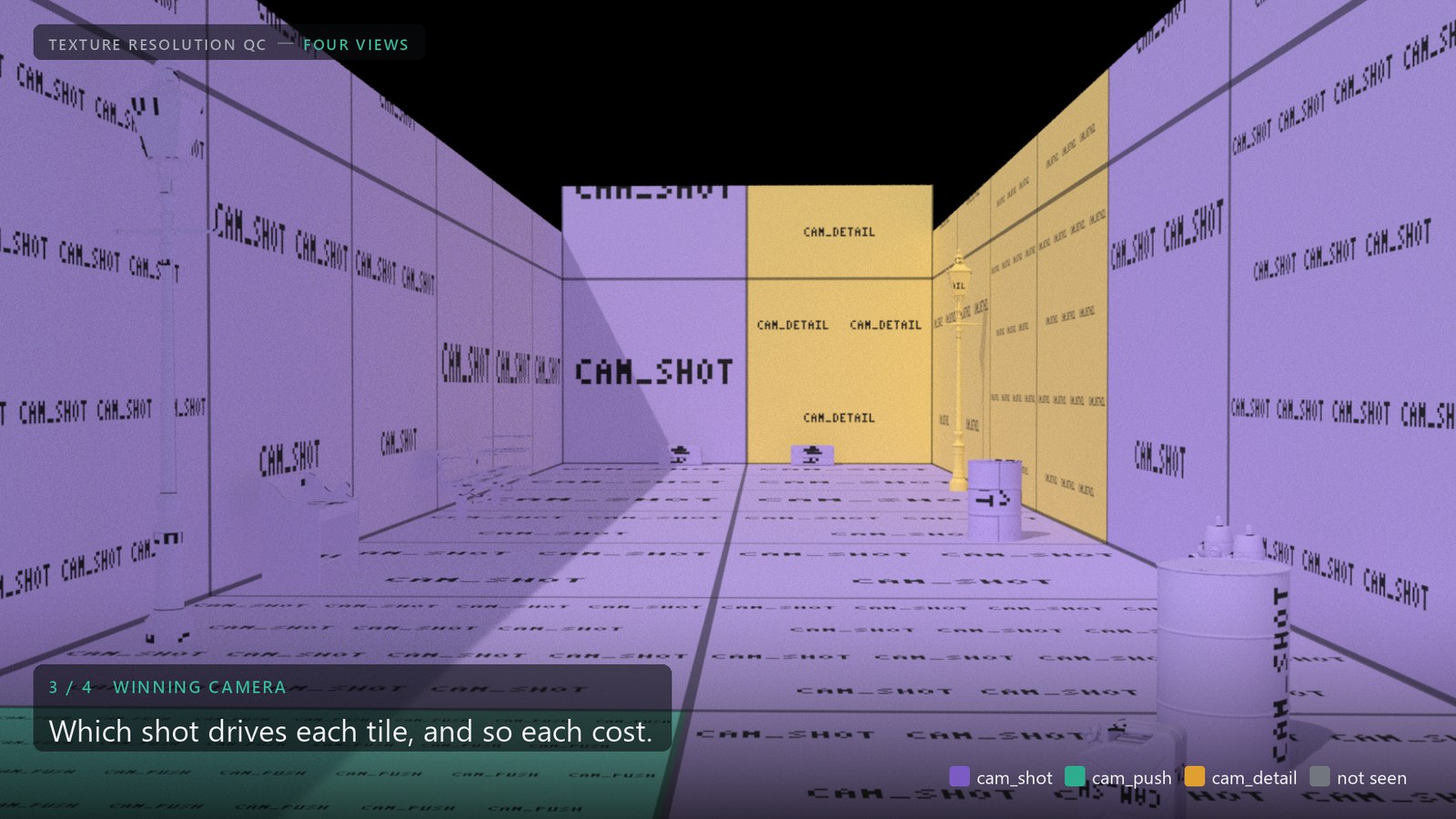
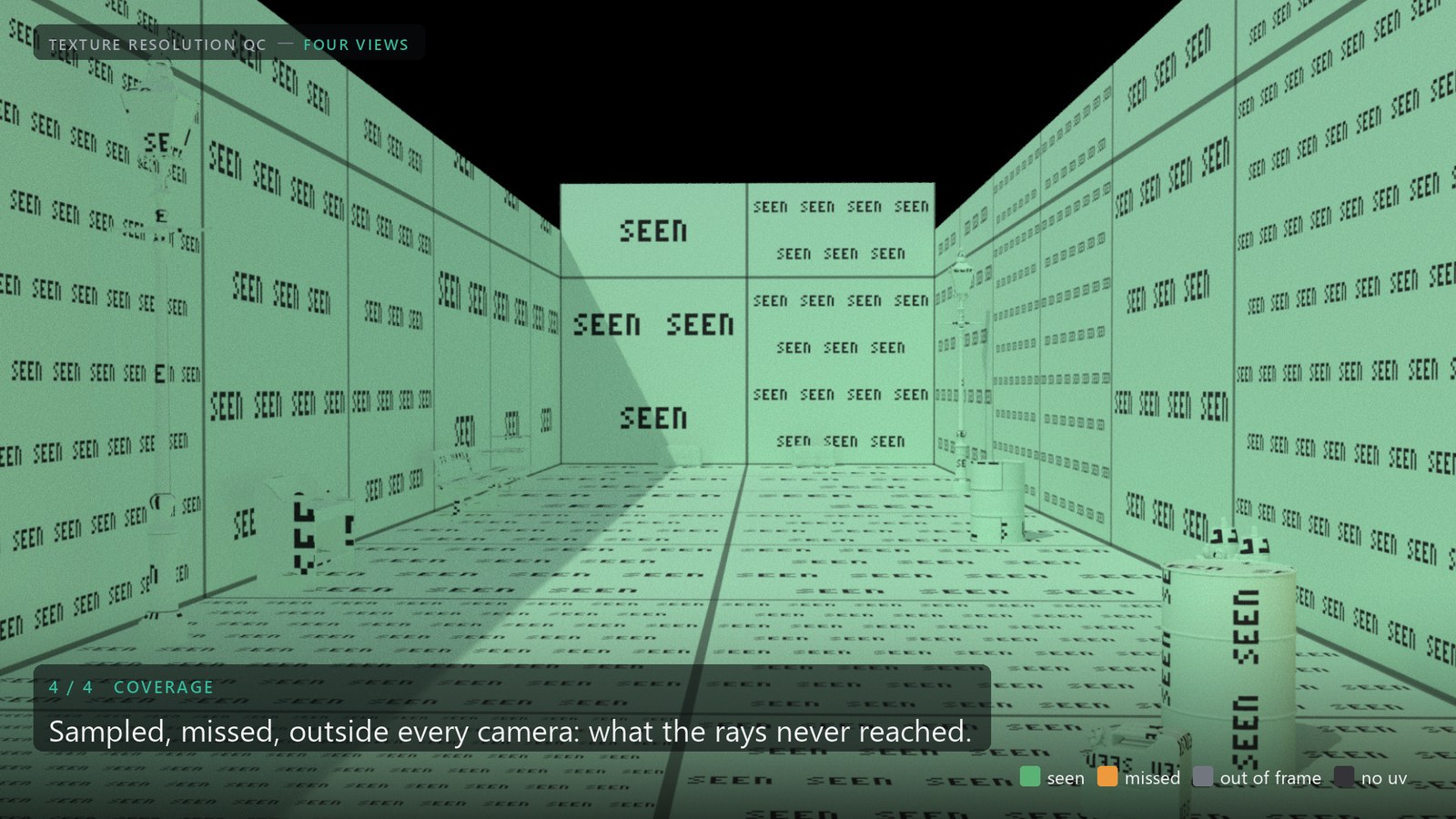
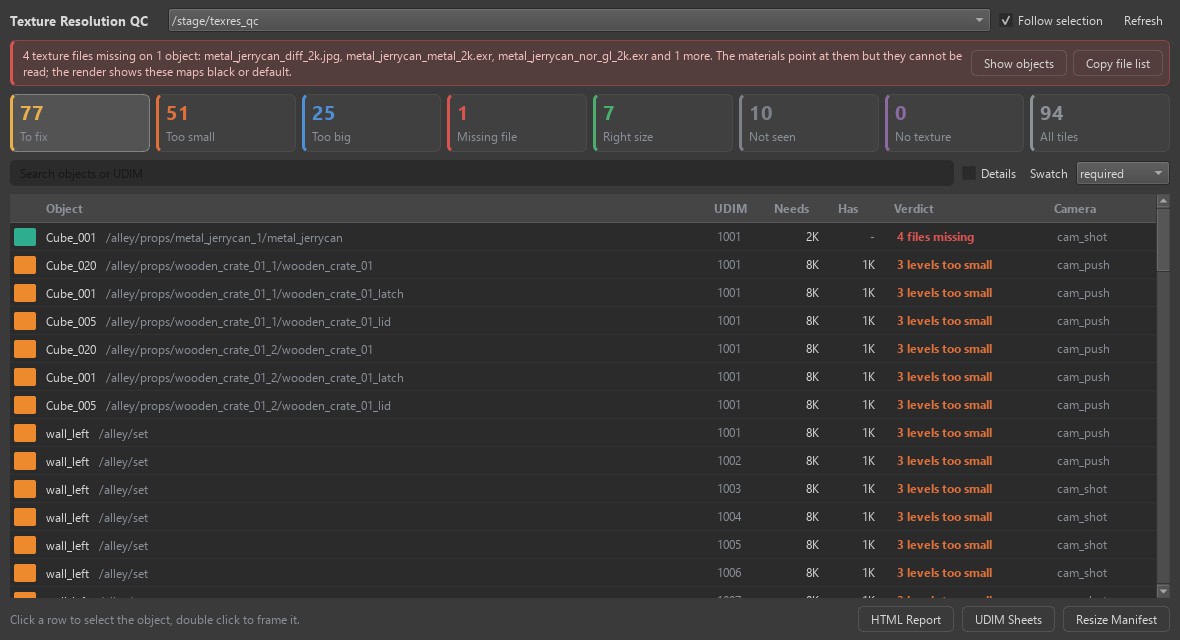
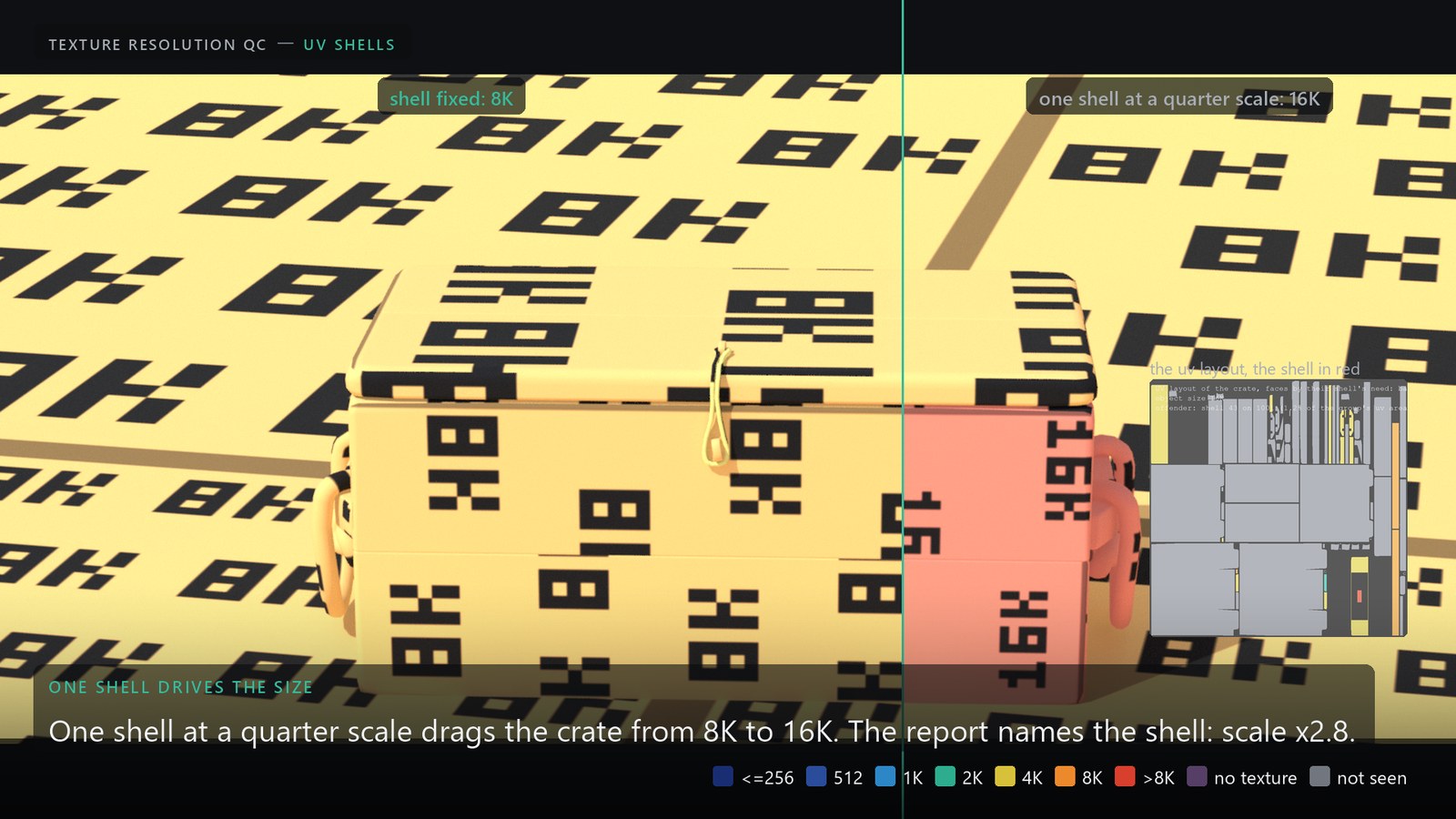
Two more views: Shell need per UV shell, and Budget. Every tile keeps its numbers as primvars (texres:required, texres:delta and more) for COPs or anything downstream.
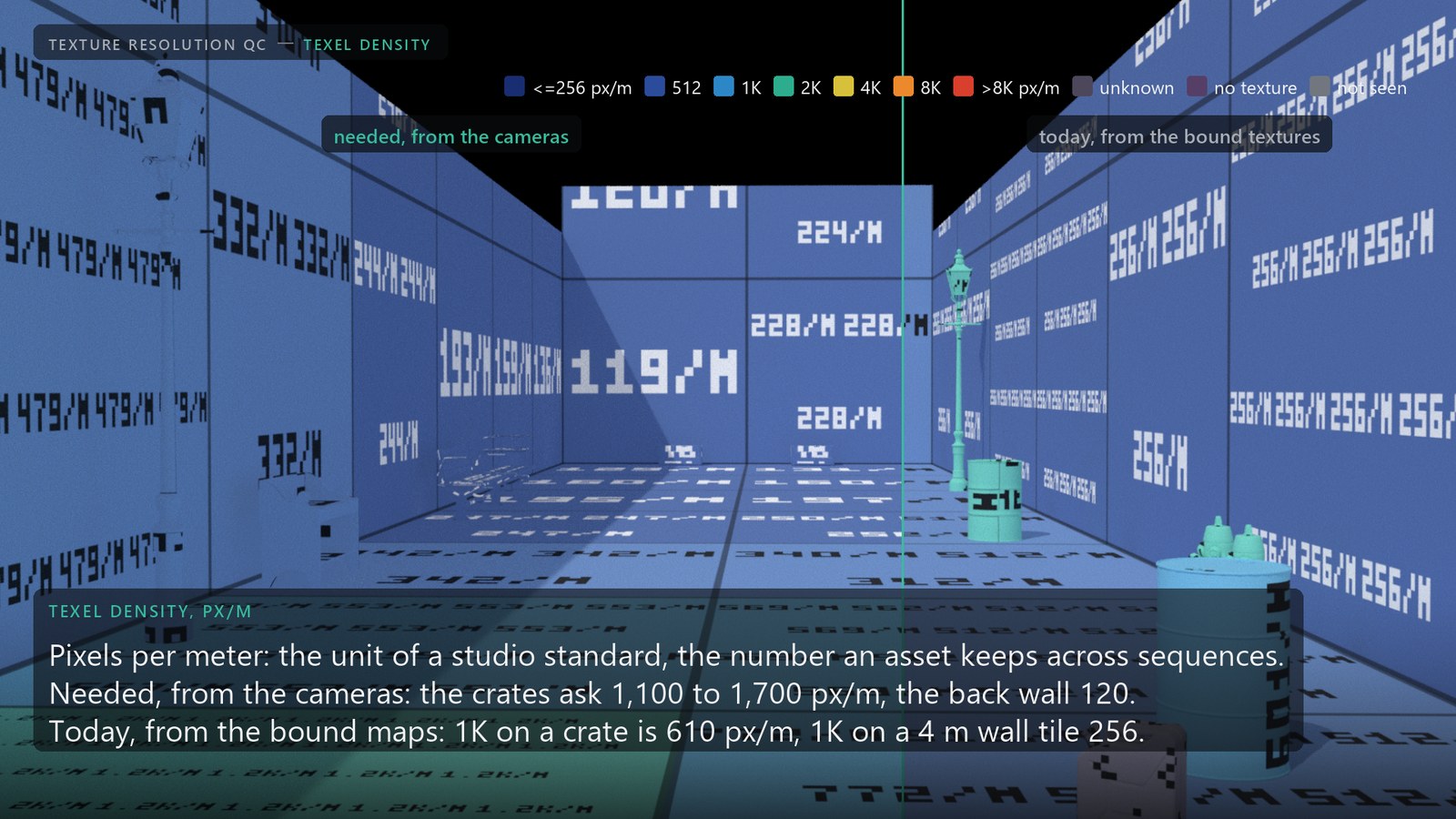
Texel density. Studio standards are written in pixels per meter, so the tool gives both sides in that unit: needed, what the cameras put on the surface (the crates 1,100 to 1,700 px/m at the end of the push-in), and today, what the bound texture gives (1K on a crate is 610 px/m).
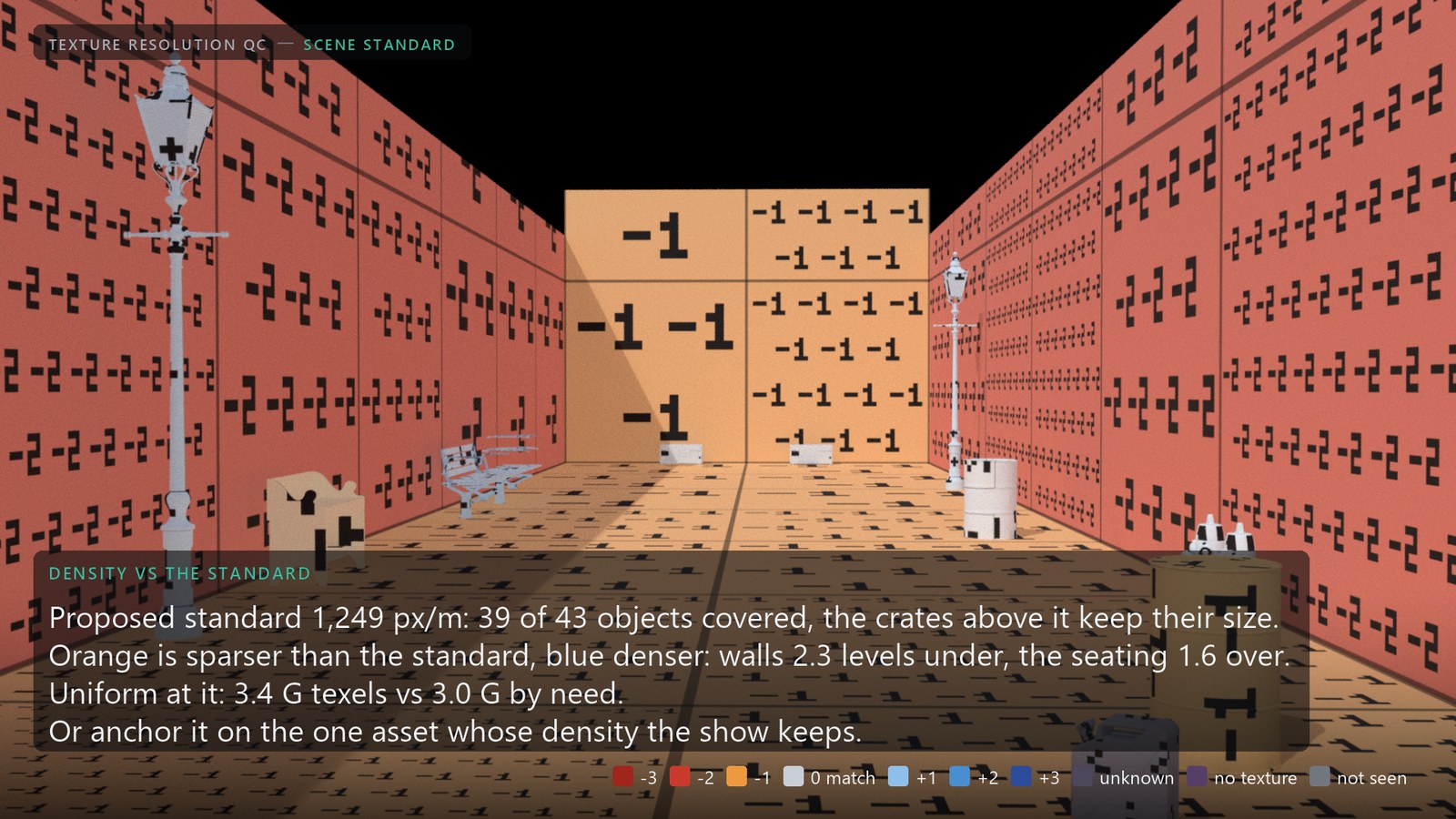
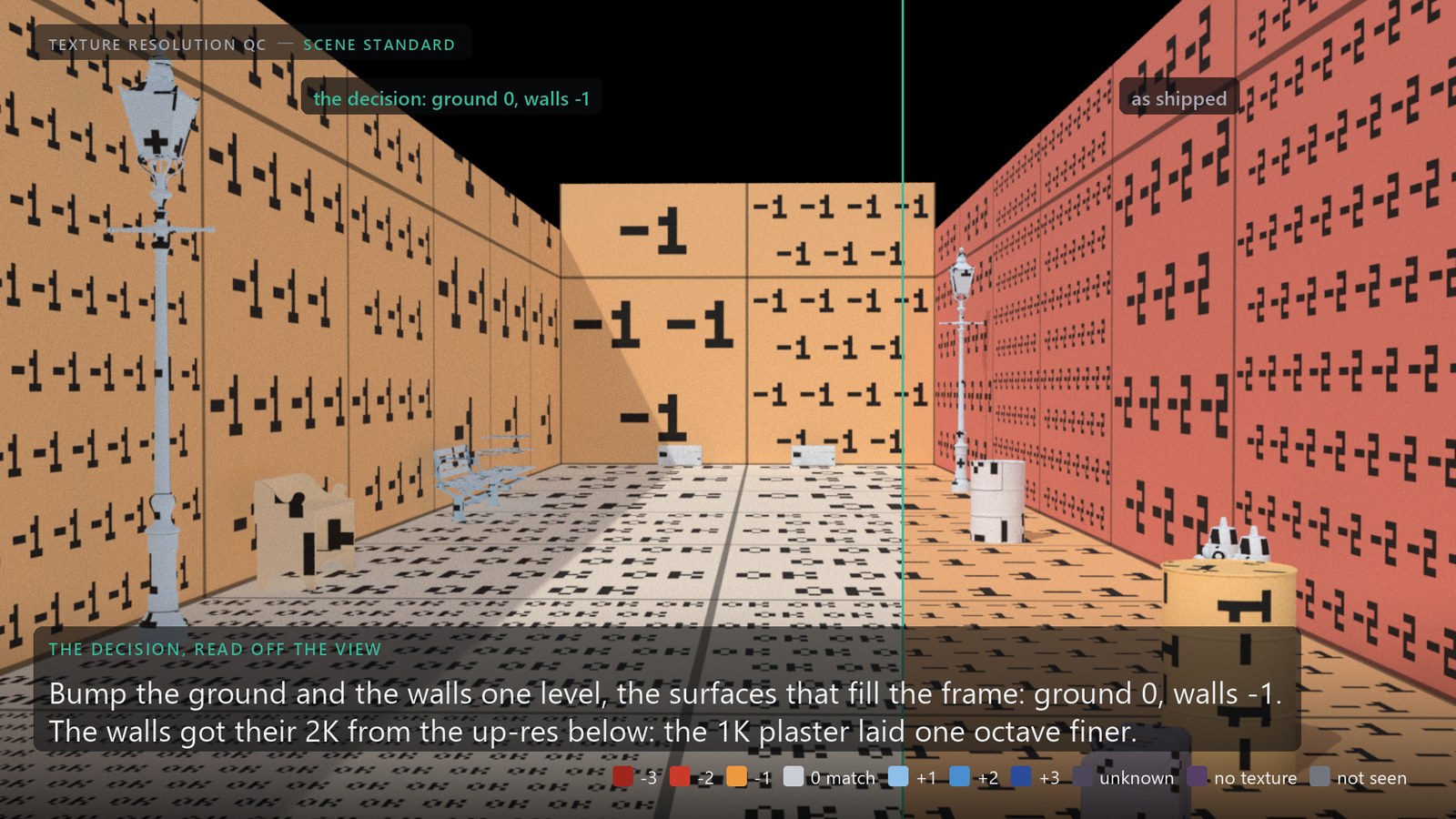
A standard. The tool proposes the smallest density that covers 90 % of the objects, 1,249 px/m on the alley, and lists the exceptions. Or name an anchor asset and its density becomes the standard. Density vs standard then shows where to spend: here the ground and the walls, one level each.
05
Beyond the simple case
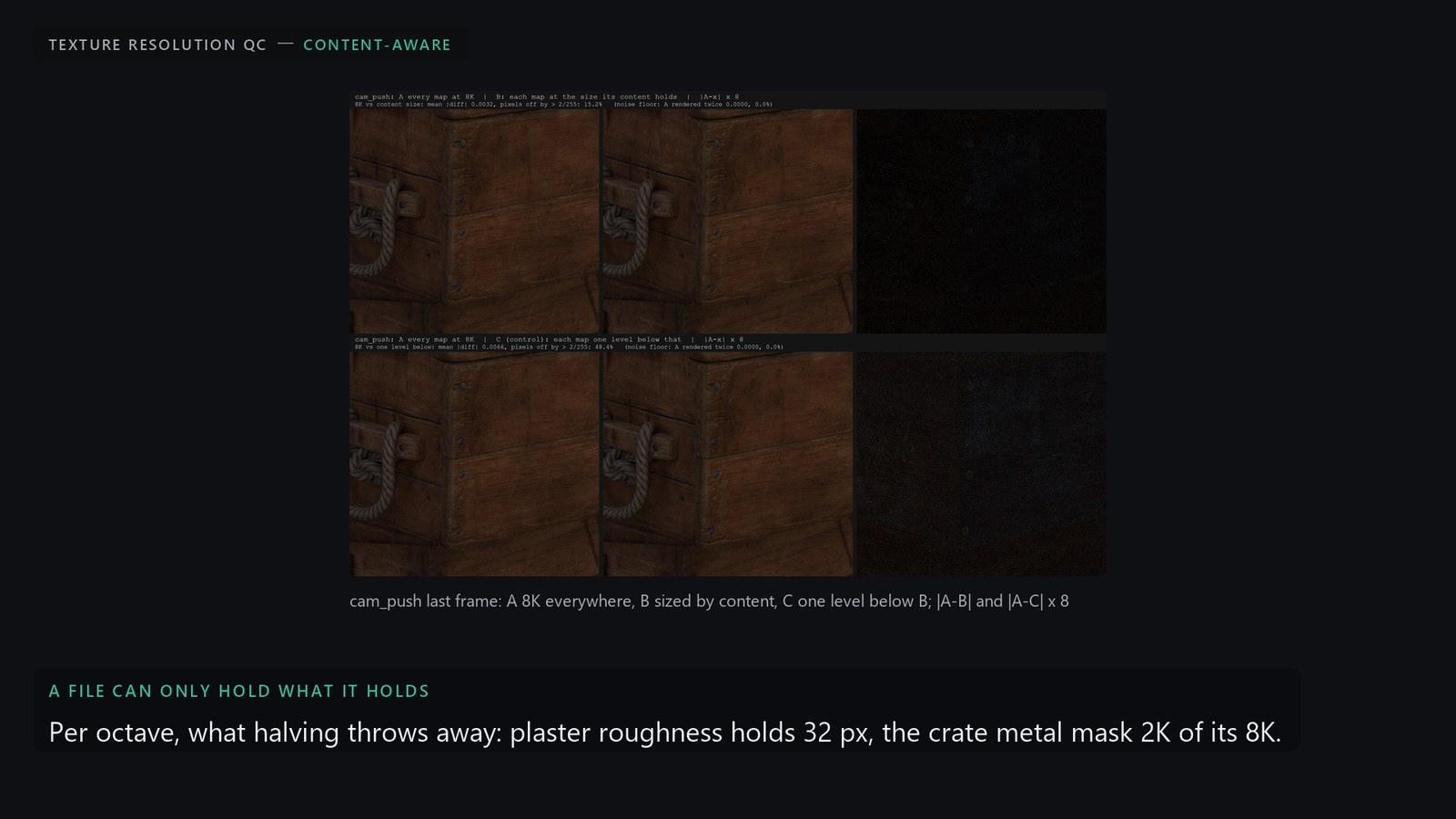
Texture budget. Give it a memory budget and it halves first the maps that save the most bytes for the least visible loss. The alley at 25 % of its 17.9 GB: the crates differ 0.0020 from the full render, against 0.0060 for halving every map.
06
Outputs
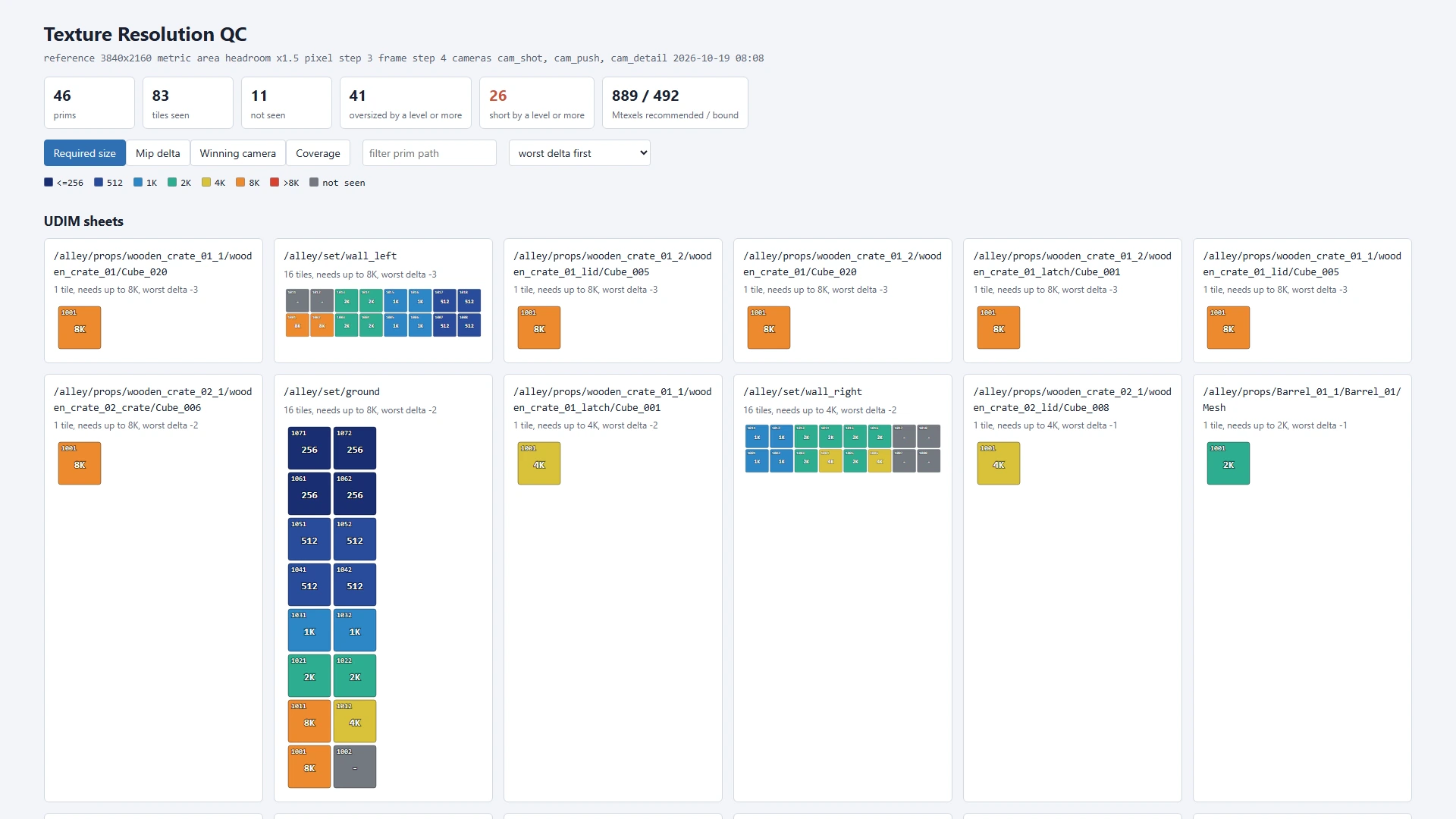
- Report, HTML and CSV.
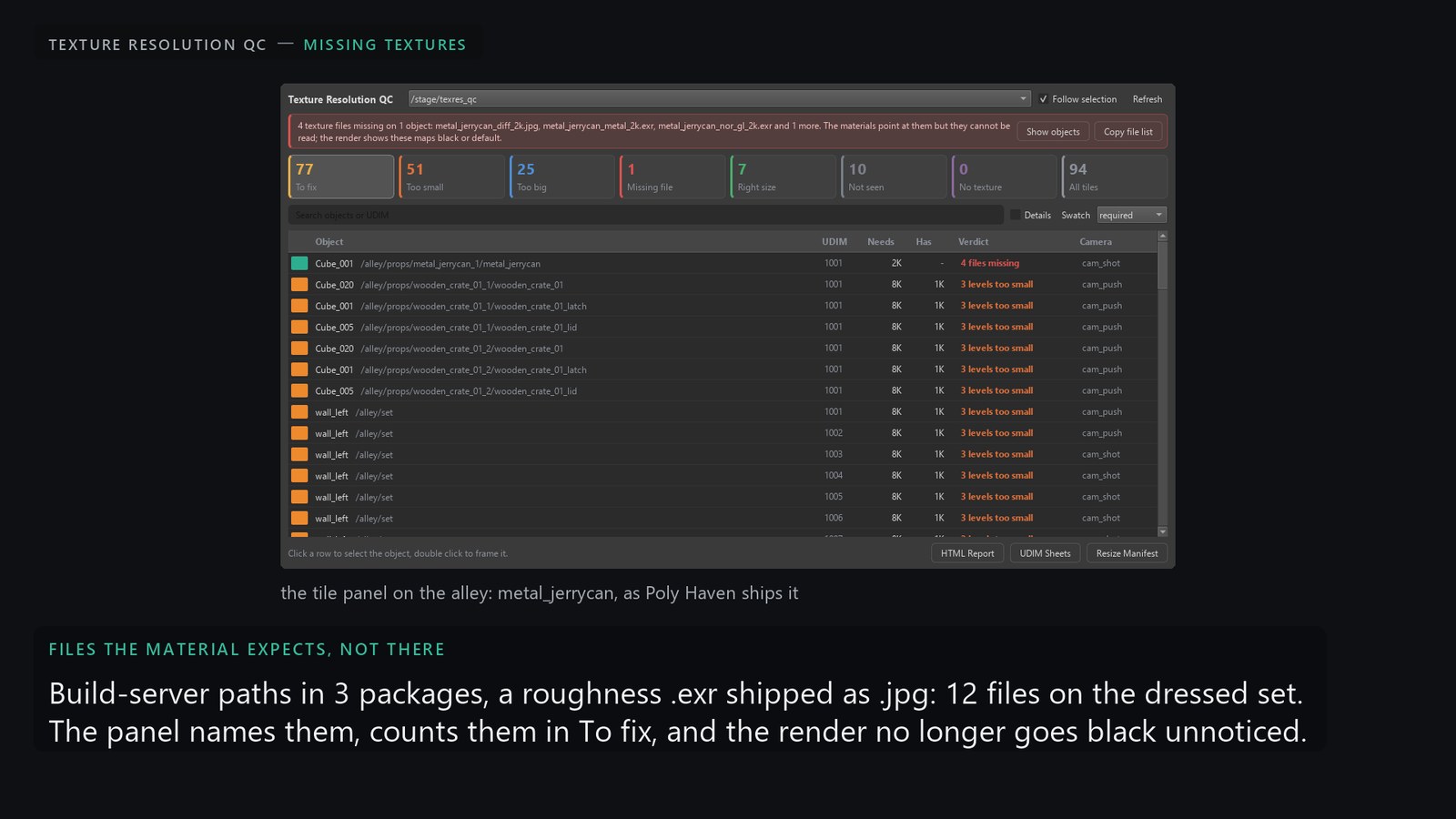
- Tile panel inside Houdini.
- UDIM sheets: a PNG per tile with the uv wireframe and its label, for Painter and COPs.
- Resize manifest: per texture file the current and target size and the action, with the matching
hoiiotoolcommands, or a COP that does it in Copernicus. - Write Resized Textures: resizes and converts to tiled, mipmapped
.txin a separate folder, plus a USD layer that points the materials at the new files. Sources are never touched.
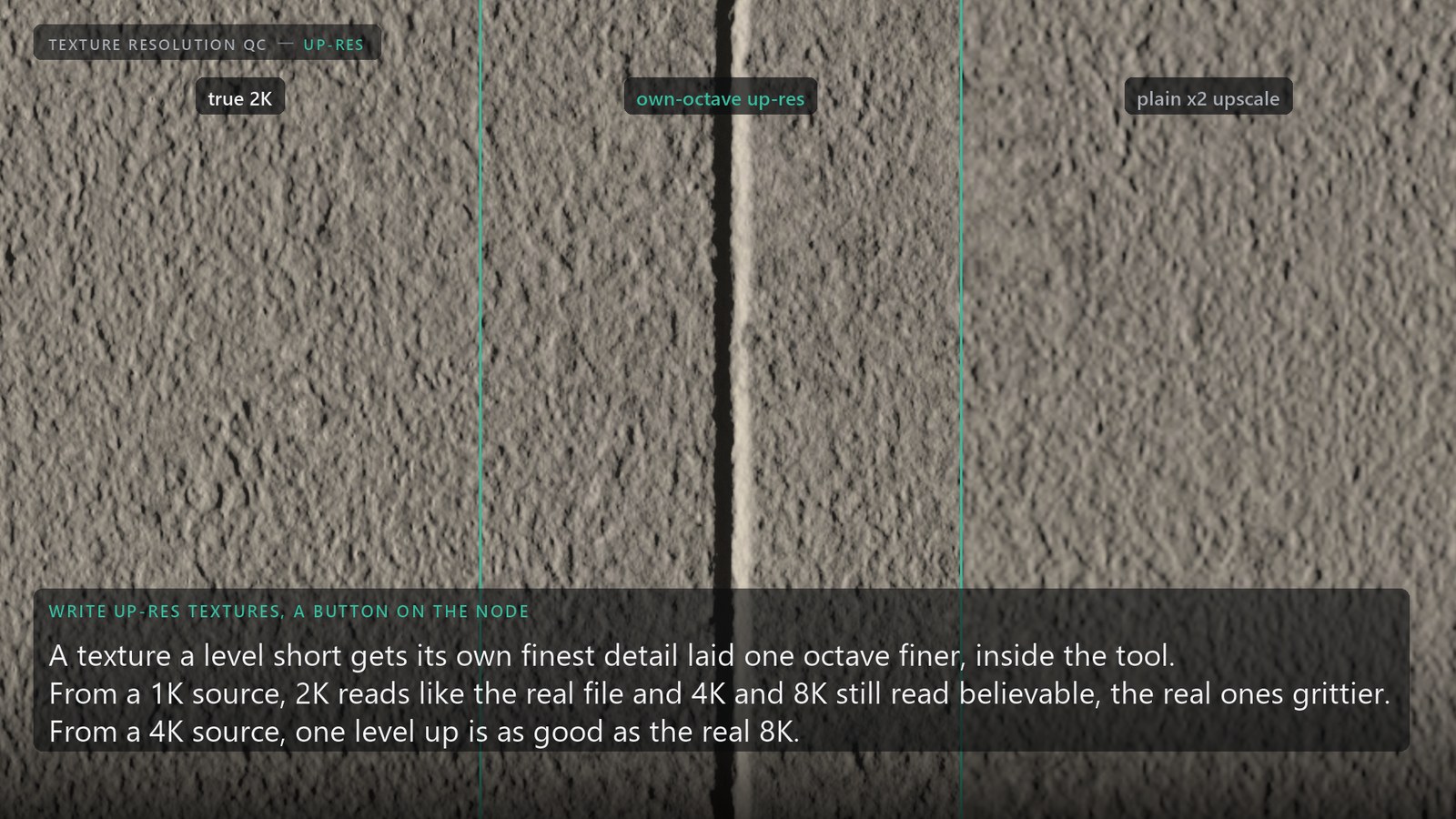
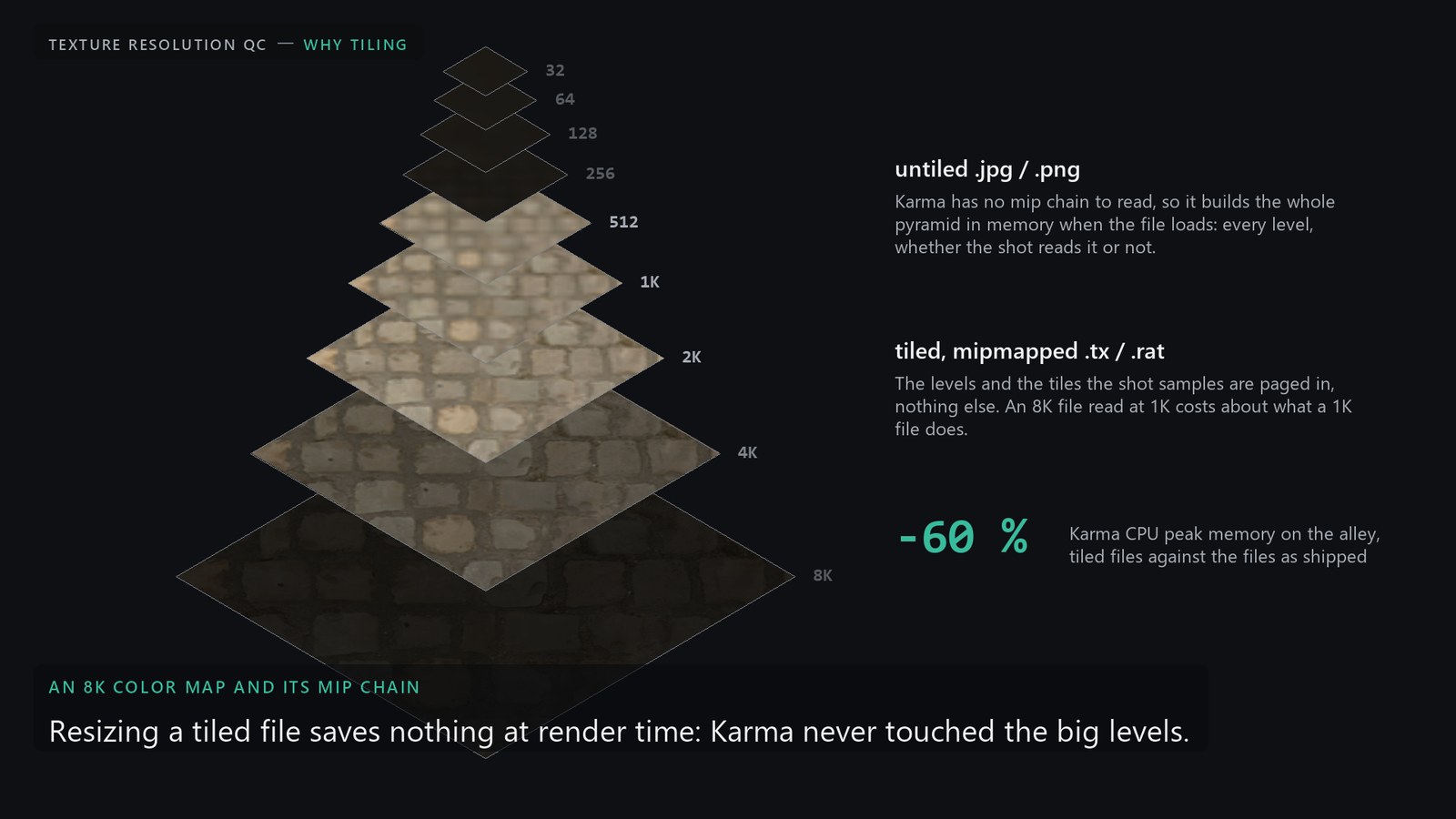
.tx is the whole optimization: it is the memory lever, changes no pixels and needs no decision per asset. Resizing is for shows where network and disk are the constraint.Write Up-res Textures. A hero asset that ships a level short cannot be re-textured overnight, and a plain upscale adds nothing. The tool adds the detail a texture already holds one octave finer: one level is honest, two a stretch. More on its own page: Texture Up-res.
07
What it bought
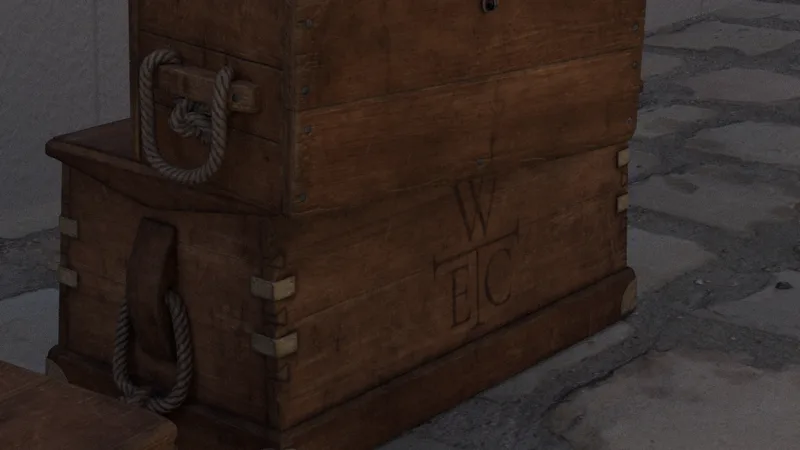
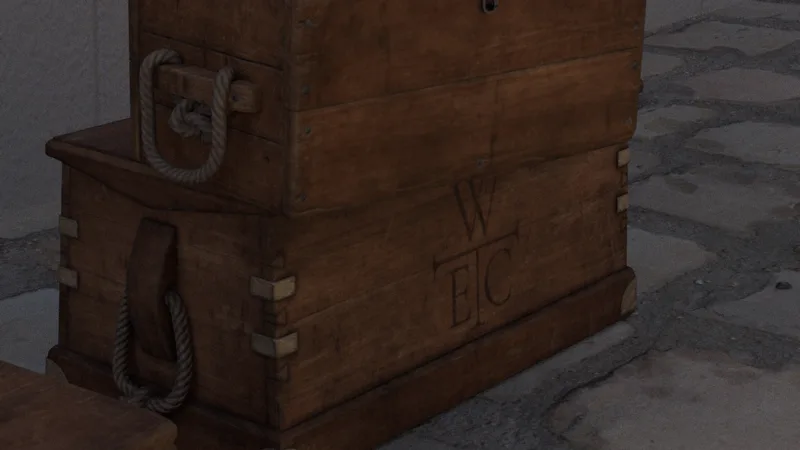
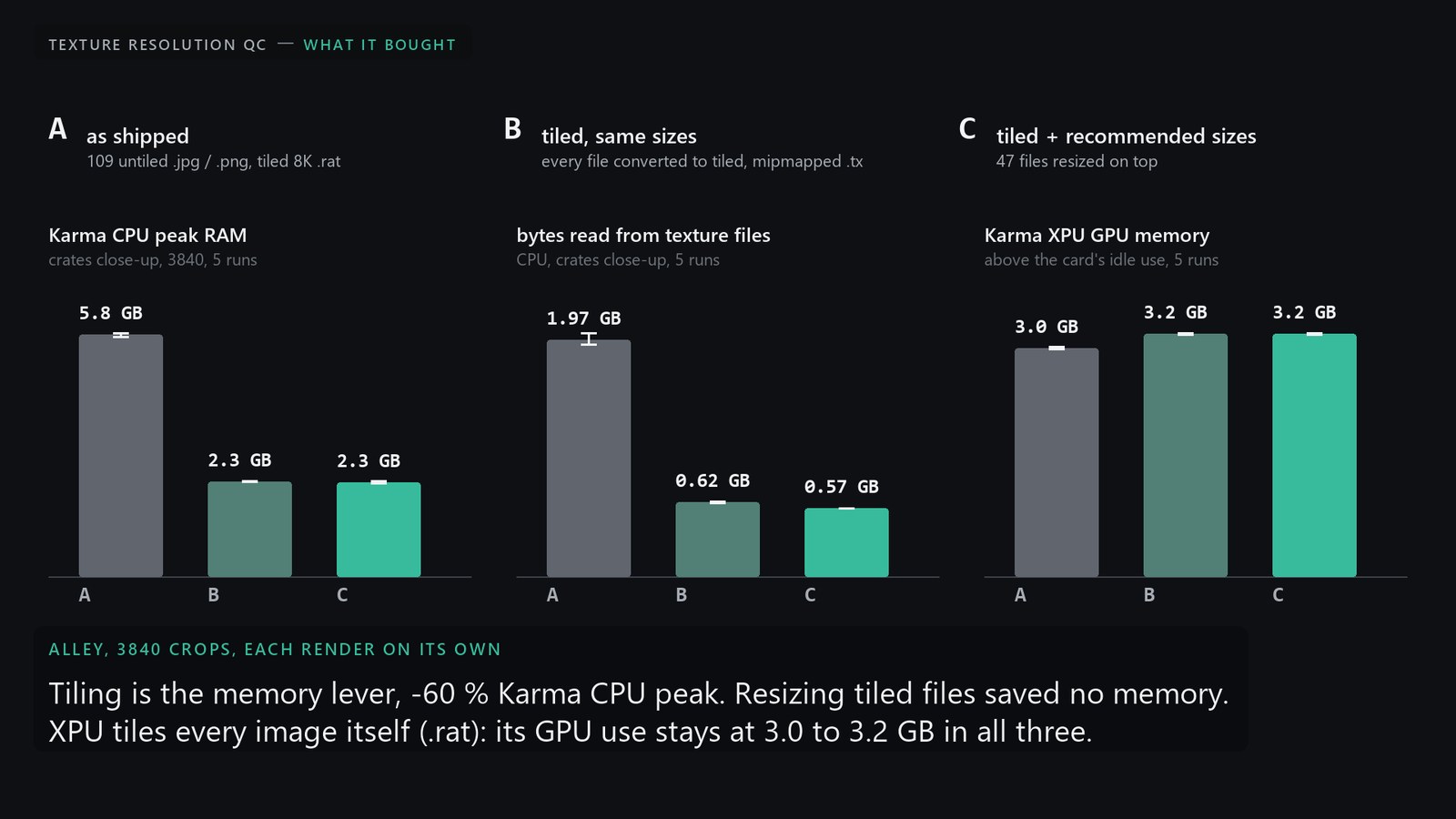
The alley with 8K crates and cobblestone, rendered with Karma in three variants, measuring peak memory, bytes read from files and GPU memory.
| Variant | Files | CPU peak RAM | CPU bytes read | XPU peak RAM | XPU GPU | XPU bytes read |
|---|---|---|---|---|---|---|
| A as shipped | 109 untiled .jpg / .png, tiled 8K .rat | 5.8 / 5.6 GB | 1.98 / 2.48 GB | 3.1 / 2.3 GB | +3.0 / +2.8 GB | 2.61 / 1.44 GB |
| B tiled, same sizes | the 109 converted to tiled, mipmapped .tx | 2.3 / 1.9 GB | 0.62 / 0.80 GB | 3.5 / 2.4 GB | +3.2 / +2.9 GB | 1.46 / 1.31 GB |
| C tiled + recommended sizes | 47 resized on top, all tiled .tx | 2.3 / 1.9 GB | 0.56 / 0.58 GB | 3.3 / 2.3 GB | +3.2 / +2.8 GB | 1.20 / 0.93 GB |
crates / cobblestone close-ups. Mean image difference against A under 0.004. Five repeat runs on the crates gave the same numbers within 0.1 GB.
08
What to take from it
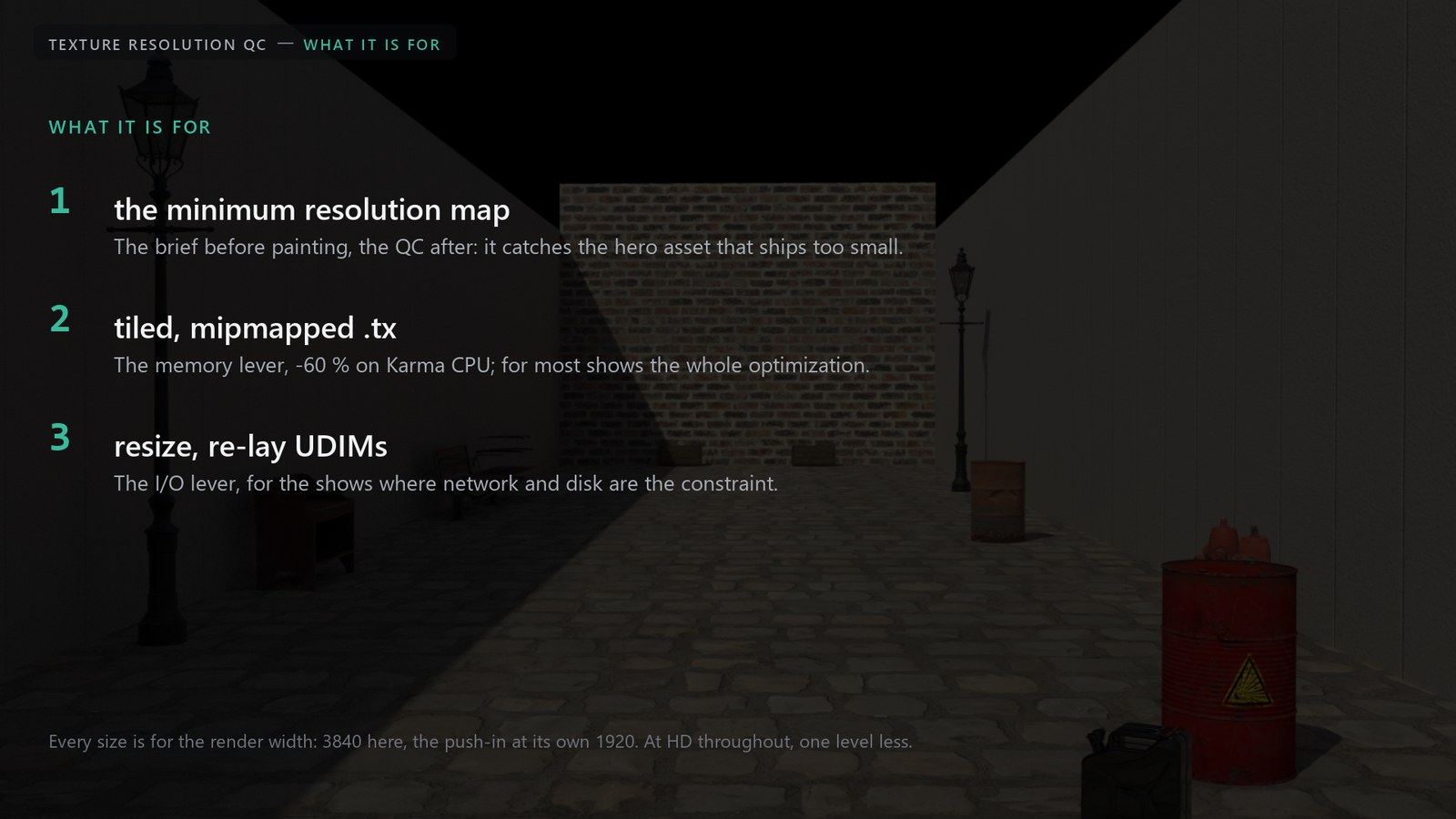
- The minimum resolution map is the point: the brief before painting and the QC after. It catches the hero asset that ships short, which no optimization fixes later.
- Tiled, mipmapped .tx is usually all the optimization a show needs.
- Resizing and UDIM re-layouts are for shows limited by network and disk.
09
Limits of v1, and what is open
- Instances: a sample of copies is traced per prototype, the rest estimated, conservatively. The image engine does not handle instancing.
- The ray engine leaves out subdivision, displacement, motion blur and depth of field; the image engine includes them. Neither follows reflections or refractions.
- Cameras move; geometry is taken at the current frame.
- For glass and cut-outs, only UsdPreviewSurface, MaterialX standard_surface and OpenPBR are read.
- Open: a standalone version outside Houdini, and a test on a production show scene.
Texture Resolution QC, October 2026. Houdini 22, Solaris, Karma CPU and XPU. Demo assets CC0 Poly Haven.